Performance Marketing Agencies for SaaS Startups
Most SaaS agencies optimize for vanity metrics while your pipeline stalls and budget disappears.

Most agencies report on what's easy to show in a slide. Impressions, click-through rates, MQL volume. These aren't useless numbers, but they're proxies. And proxies can be gamed or misread without anyone technically lying.
Here's what this looks like in practice: MQL volume trends up every month. The agency sends confident emails. You feel good. But pipeline velocity is flat, and your sales team keeps saying the leads don't convert. Nobody lied. Someone just built a slide deck around a number that didn't mean what they implied it meant. That gap between "technically accurate" and "actually useful" is where a lot of seed budgets quietly disappear — like water through a cracked pipe, steady and invisible until the damage is already done.
The metrics that actually matter in SaaS:
- Pipeline contribution. How much of your active sales pipeline traces back to a marketing touchpoint?
- CAC by channel. Not blended. Not estimated. Actual cost per acquired customer, broken out by source.
- Payback period. How many months of gross margin does it take to recover what you spent acquiring that customer? This number should exist before you scale a channel, not six months after you've been scaling it.
- Pipeline velocity. How fast do deals move from first touch to close, and do marketing-sourced deals move faster or slower than other sources?
Refine Labs built a significant reputation arguing that most B2B SaaS demand generation was measuring the wrong thing entirely. The fact that this became a widely debated position says something uncomfortable about the industry. It shouldn't have been controversial. It was obvious to anyone who had spent real time inside one of these funnels, watching the MQL count climb while the sales team sat in front of an empty pipeline wondering what was going on.
An agency that can't connect its work to ARR contribution isn't a performance marketing agency. It's a traffic agency in SaaS clothing.
Your Stage Determines Which Levers Actually Exist
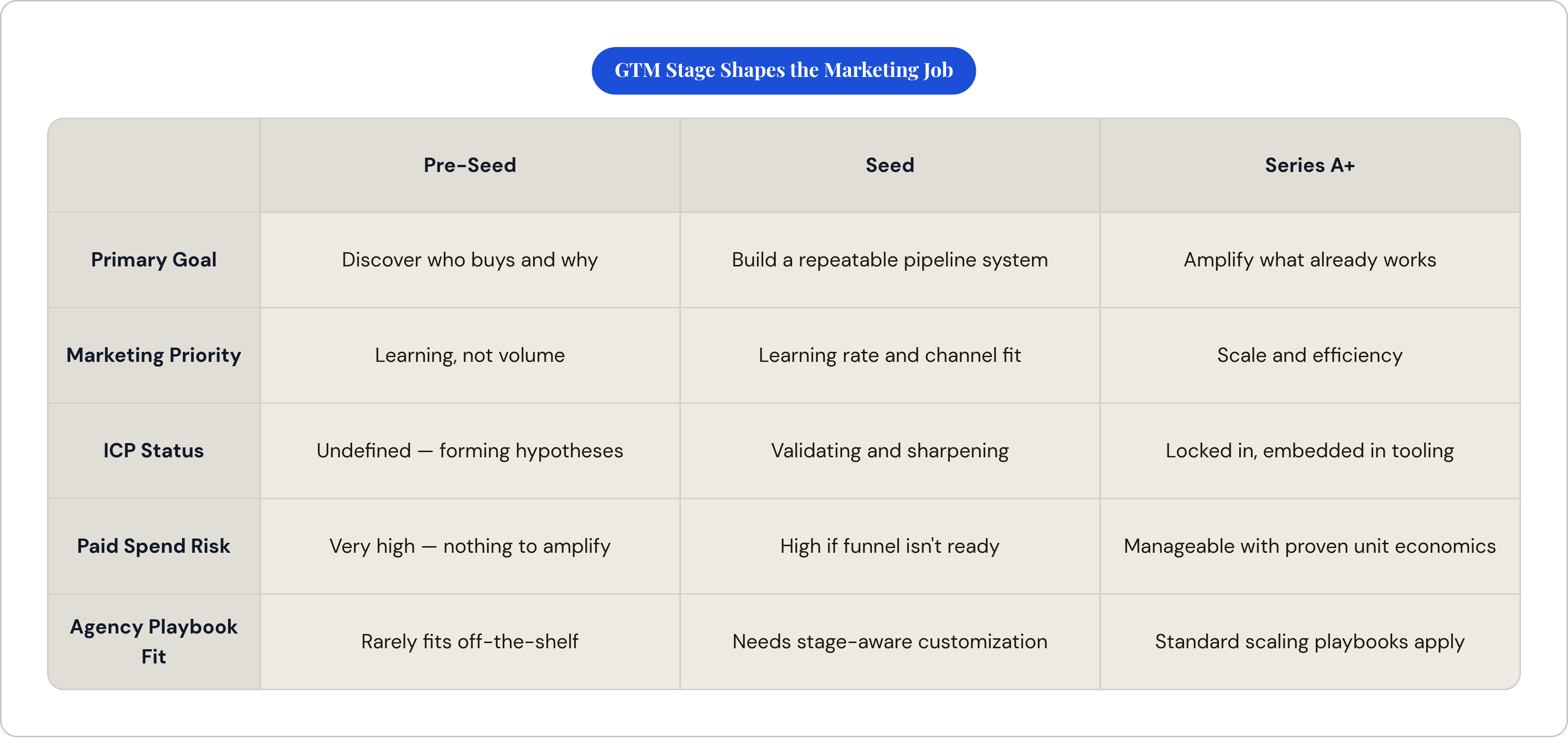
A very common and very expensive agency failure is applying a scaling playbook to a company that hasn't figured out what it's scaling yet. Agencies don't do this maliciously. They do it because their playbook was built for a different stage, and sometimes nobody in the room catches it until three months of budget are gone.
There are three distinct GTM stages, and the job of marketing is completely different at each one:
- Pre-seed: You're learning. Who buys this, and why? Nothing is repeatable yet, and that's fine. That's the whole point of the stage.
- Seed: You're building. You take what you learned and start turning it into a system that generates consistent pipeline.
- Series A and beyond: Now you scale. You amplify what already works.
Most agencies are built for stage three. Their playbooks assume a validated ICP, proven messaging, and a funnel that already converts. Drop that playbook into a seed-stage company and you will burn budget without generating a single useful signal. The agency will have done exactly what they said they'd do. It just won't have helped you.
At seed, the priority isn't volume. It's learning rate. You want to find the one or two channels where your ICP actually responds. Running ten channels simultaneously and calling it a strategy is how you confuse activity with progress. I've watched founders do this. It feels productive right up until the moment they have to explain the spend to a board member — which is a bit like rearranging deck chairs and calling it navigation.
One of the more painful mistakes at this stage: allocating serious budget to paid acquisition before your messaging and funnel are ready to convert. Paid spend amplifies what already exists. Including a broken funnel. Especially a broken funnel.
When you evaluate an agency, don't just ask if they've worked with SaaS companies. Ask if they've worked with SaaS companies at your stage specifically. Ask what they built for those companies versus what they scaled. Those are genuinely different answers, and most agencies will stumble a little on the distinction, which is itself useful information.
ICP Clarity Comes Before Performance Marketing. Not Alongside It.
Performance marketing without a defined ICP is just targeting practice. It generates data about who clicked, not about who should have. Those are very different datasets. Conflating them is how you end up with a CRM full of leads your sales team quietly ignores.
For B2B SaaS, an ICP is an account-level description. Not just the buyer as a person. The type of company most likely to get real value from the product and stick around. That second part, the staying, is what most ICPs miss. It's also the part that shows up in your churn numbers twelve months later.
Three layers make an ICP actually usable:
- Firmographics. Company size, industry, geography, tech stack. The static profile. The starting point, not the endpoint.
- Triggers. Events that signal urgency right now. A new VP just got hired. A funding round just closed. A compliance deadline is approaching. Triggers separate a company that fits your profile from one that's actually ready to buy today.
- Macro trends. Why does this problem matter more this year than last? The tailwind that makes a pitch land is part of the ICP because it shapes the message.
The two most common ICP failures are easy to spot in retrospect, which is annoying because they're also easy to spot in advance if you know what to look for. First: an ICP so broad it excludes no one. No targeting discipline means no targeting, period. Second: an ICP that exists in a Google Doc but never gets embedded in CRM scoring or ad targeting. That's not an ICP. That's a writing exercise with a fancy name.
An agency that skips ICP validation and moves straight to campaign setup is optimizing toward whoever happens to click. That is not the same as optimizing toward accounts likely to become high-LTV customers. The difference doesn't show up in next week's campaign report. It shows up in your churn rate six months later, and by then the agency has usually moved on to talking about the next campaign.
Before you sign anything, find out whether the agency will help you validate or sharpen your ICP, or whether they'll accept your current assumptions and run with them. One of those approaches is worth paying for. The other one is just faster.
Channel Decisions at Seed Are Architectural, Not Tactical
There is no correlation between how many channels a startup uses and how fast it grows. Depth in a small number of the right channels beats surface coverage across many. Every time. This isn't a contrarian take. It's just what happens when you look at what actually worked for companies that made it through seed to Series A with clean unit economics.
The right channels depend on your GTM motion, and your GTM motion is an architectural decision a good agency should help you surface. Not assume.
- Product-led growth (PLG) works when ACV is low, the product can demonstrate value without a sales conversation, and the buyer can self-serve through evaluation.
- Sales-led growth (SLG) works when ACV is high enough to justify a real sales cycle, product complexity requires a human in the loop, or buyers need relationship and trust before committing.
- Hybrid is increasingly common, especially as PLG companies add enterprise tiers and SLG companies add self-serve entry points.
Once you know the motion, channel choices follow a logic:
- Organic content and SEO. The highest-quality inbound channel in B2B SaaS, mostly because organic visitors arrive pre-qualified through their own research. The content compounds over time. But it requires runway to build and doesn't produce fast results, which is exactly why seed stage is the right time to start.
- Paid search and paid social. Fast feedback on messaging and ICP assumptions. Useful for learning. But requires a funnel that converts and unit economics that support the cost. B2B paid cost per lead is substantially higher than organic, so "let's just run some ads" is not a plan. It's a way to feel busy.
- Outbound. Useful at seed for high-ACV, sales-led motions where you know exactly who to target. Not a scalable foundation for most SaaS companies long-term, and often overused precisely because it produces activity that looks like progress.
- Demand creation (LinkedIn, podcasts, dark social). Builds brand presence in channels where buyers spend time before they enter a formal buying process. Slower to attribute, sometimes impossible to attribute cleanly. But often the reason a paid or outbound motion eventually converts at all.
An agency recommending a channel mix should be able to explain why each channel fits your motion, your ACV, your sales cycle length, and your current funnel state. If the explanation starts with "we're really good at running it," that's not a strategy. That's a services menu.
Content and SEO Aren't Brand-Building. They're Pipeline.
Content has been sold as everything from thought leadership to community building to brand awareness. Its actual job in SaaS is narrower and more valuable than any of those things: generating pipeline from buyers who are already in the market but haven't raised their hand yet. That's it. Everything else is a secondary benefit at best.
A large share of B2B SaaS pipeline originates from organic search. Buyers who find a product through their own research, not through an ad or a cold email, arrive more informed and close at higher rates. Most B2B buyers now prefer self-serve evaluation before speaking to sales, which means your content, your documentation, and your trial experience are functioning as the first sales conversation whether or not a human is involved. Treating content as separate from the sales process isn't just a strategic mistake. It's a structural one that compounds quietly for months before you notice.
The compounding argument for content at seed is real in a way that's easy to underestimate. A founder with a year or more of runway before needing to demonstrate traction for a Series A has enough time for content investment to break even and start generating durable pipeline. Most founders skip it anyway, then wonder later why their organic presence is thin. Starting late doesn't mean you can't catch up, but it means you'll be paying for traffic at exactly the moment you'd rather be showing investors efficient acquisition costs.
There's also a structural shift in the landscape that any serious content agency should be navigating right now. AI assistants are increasingly answering queries that used to drive organic clicks. A meaningful share of searches now end without a click to any website. The implications for traditional SEO are real and already showing up in traffic data. Leading agencies are repositioning around generative engine optimization (GEO) and answer engine optimization (AEO), making sure their clients' content gets cited in AI-generated answers from tools like Perplexity and ChatGPT, not just ranked on traditional results pages.
An agency operating purely on traditional SEO without a view on this shift is building on ground that is actively moving. Ask them about it directly. If they look at you blankly or pivot to talking about domain authority, you have your answer.
Consistency in publishing matters too, more than most people want to hear. Teams that publish on a reliable cadence see meaningfully better results than those that publish sporadically, because the compounding effect requires volume over time. One great article per quarter is not a content strategy. It's a hobby.
Pricing Structure Tells You Who the Agency Is Actually Working For
Most agencies price on a retainer plus a percentage of spend. That structure creates a direct financial incentive to increase your budget, which is not the same thing as increasing your efficiency. At seed stage, those two things are often pulling in completely opposite directions. Before you sign anything, figure out exactly how the agency makes more money, because that's the behavior you'll get.
The right incentive structure rewards results at controlled cost. Not volume.
The agency landscape has segmented meaningfully by stage. Some firms, like SaaSHero, have built offerings specifically for founders at early ARR levels: lower entry price, a dedicated manager, integrated revenue reporting rather than impression decks. Others, like Directive Consulting and NoGood, operate at higher retainer levels with longer contract expectations. That can make complete sense for companies with validated channels and larger budgets. At seed, it creates vendor lock-in risk against assumptions you're still in the middle of testing, which is a different problem entirely.
Month-to-month flexibility matters more at seed than at any other stage. Your strategy and ICP understanding are still being validated. Locking into a six-to-twelve month contract against assumptions that will shift in month three is a structural risk, not just a financial one. And it creates a dynamic where you're paying for confidence in a direction you've already moved away from.
Before signing, ask three things:
- What does your reporting actually connect to? Impressions and MQLs, or pipeline and ARR?
- How long is the minimum contract, and what happens if our strategy shifts mid-engagement?
- How do you get paid, and does your compensation go up when we spend more?
The answers tell you whose interests the engagement is actually designed to serve.
The Agency's Job Isn't Execution. It's Building the Engine.
Investors evaluating a Series A are not reading marketing reports. They're reading the growth story that marketing produced: ARR trajectory, CAC efficiency, pipeline velocity, and evidence that the acquisition model is repeatable. None of that gets built in the six months before a raise. It gets built in the months immediately after closing seed, when most founders are still deep in figuring out who they're actually selling to and why those people buy.
That window is shorter than it feels at the time.
The right performance agency for a seed-stage SaaS company doesn't just run campaigns. It builds the engine. That means:
- Validating and sharpening the ICP before spending against it.
- Connecting positioning to messaging to channel strategy in a coherent sequence, not as three separate workstreams that happen to share a Slack channel.
- Instrumenting the right metrics from the start. CAC by channel, pipeline velocity, payback period. Retrofitting measurement after the fact is slower, messier, and produces data you can never fully trust.
- Staying close enough to the founder's workflow to know when the strategy needs to change, not just when a campaign needs a refresh.
Founder-led sales is a starting point. It's how most SaaS companies find their first customers. The marketing engine is what turns those early conversations into a repeatable acquisition system that a Series A investor can actually underwrite.
The evaluation question, stripped down: does this agency measure what actually moves the business, and do they understand what stage you're in? Not what stage they'd prefer you to be in. Not the stage where their playbook fits cleanest. The stage you're actually at, right now, with the budget and assumptions you actually have.
Answer those two honestly and you'll know pretty quickly whether they're going to help you build something or just keep you very expensively busy.