Best B2B Demand Generation Agencies for Startups
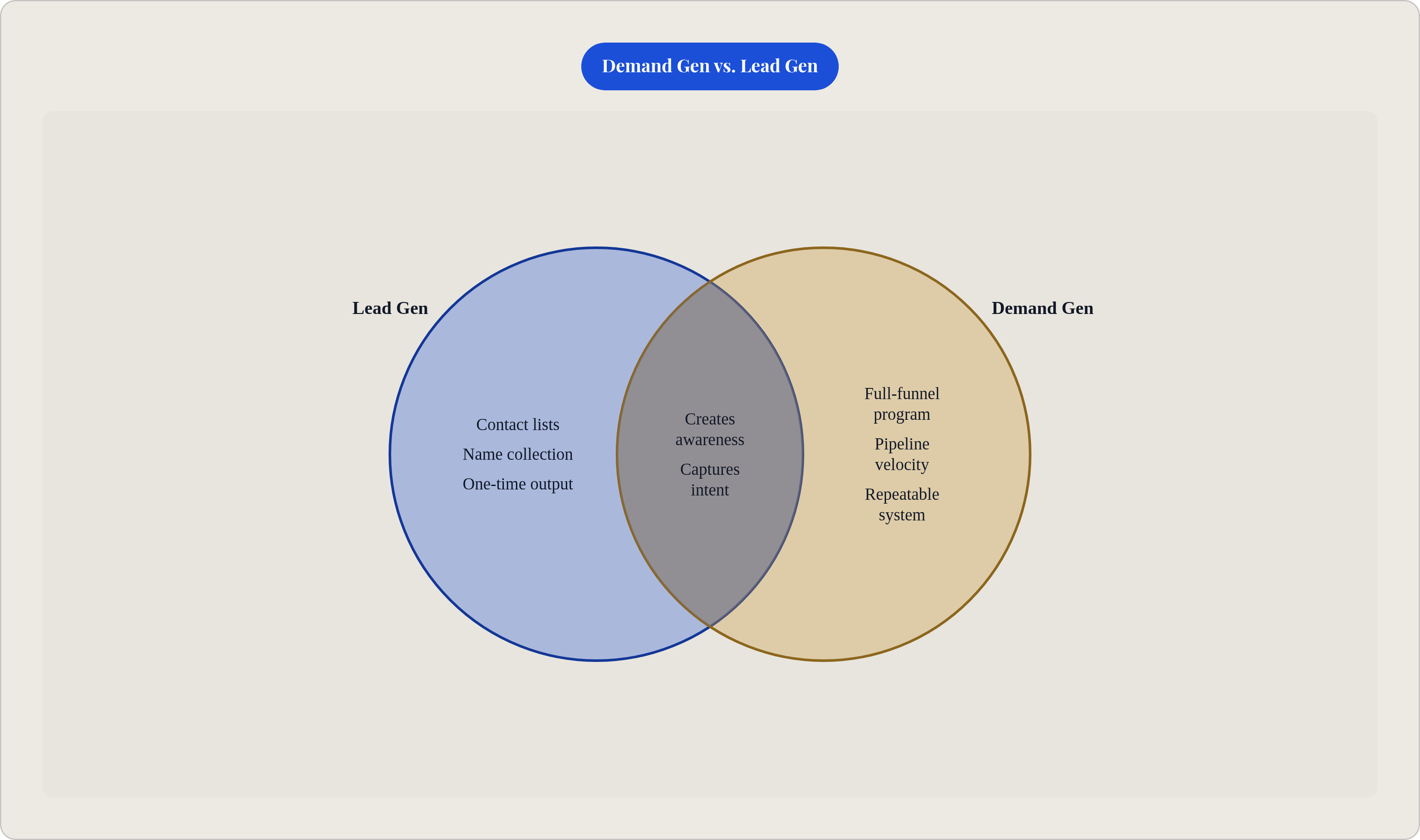
First, a distinction worth making: demand gen is not lead gen.
Lead gen fills a spreadsheet with names. Demand gen builds a full-funnel program that creates awareness, captures intent, and converts interest into revenue. Founders who blur this line end up hiring agencies that hand over contact lists and call it done. It's an expensive way to learn the difference, and most learn it the hard way.
At seed stage, the actual job is two things happening at the same time: figuring out who is buying this and why, and building something repeatable out of what you learn. You cannot skip the first part to get to the second. I've watched agencies try. They burn runway optimizing a system that isn't even pointed at the right people yet.
Think of GTM in rough phases. Pre-seed is discovery. Seed is building the system. Series A is scaling what already works. An agency that skips straight to scaling is simply wrong for this stage.
What does seed-stage demand gen actually look like in practice? Honestly, less glamorous than most agency proposals make it sound. It's a founder manually prospecting 15 to 25 tightly defined accounts per week. Closing five to ten reference customers. Using the exact language those customers gave you to rewrite your positioning. The success signals are specific: a 20 to 30% reply rate on personalized outbound, a 40 to 60% demo-to-close rate on right-fit accounts, and a handful of reference customers who will actually pick up the phone for you.
On channels: under $1M ARR, your highest-leverage bets are product-led growth, founder brand on LinkedIn, and tightly scoped outbound. Not conferences. Not broad SEO plays. Not ABM programs designed for large enterprise buying groups with dedicated procurement teams.
Running eight channels at half effort produces less than running two channels well. A good agency for this stage makes you do fewer things, not more. That's usually the first sign you're talking to someone who actually gets it.
The ICP and positioning work that has to come before any agency can generate demand
No demand gen strategy works without a precise ICP. Not a broad market definition, not a persona template downloaded from a marketing blog. A validated understanding of who actually converts, stays, and expands.
For B2B, that means firmographic specifics: industry, company size, tech stack, buying process, and what trigger events cause someone to start looking for a solution like yours. Job title alone is not an ICP. I know that sounds obvious. You'd be surprised.
Most founders find out the hard way that the ICP document describes the market they want to serve, while the segment that actually converts and renews is often a different one entirely. An agency worth hiring helps close that gap rather than assuming you've already solved it. Many agencies just take your ICP doc at face value, run with it, and you don't figure out it was wrong until month four.
There's also the buying group problem. Modern B2B deals involve multiple stakeholders. An ICP that only names the economic buyer leaves too much guessing at every stage of the funnel. Messaging needs to account for the whole room, not just the person signing the contract.
Positioning is the other half of this. Messaging has to translate your product into buyer outcomes, not features. Buyers are not purchasing "a report automation tool." They are buying three hours saved per week, per manager. The framing has to live in their world, not yours.
Worth noting: a large share of tech buyers say online information alone is enough to build a vendor shortlist without ever talking to a sales rep. If your positioning doesn't land in that self-serve research phase, you don't get a second chance. Nobody calls you to tell you they ruled you out.
Before signing anyone, ask whether the agency sharpens ICP and positioning as part of onboarding, or whether they assume you've already done that work. The answer tells you a lot.
The criteria that actually matter when evaluating a demand gen agency as a startup
The right question isn't "who is the best demand gen agency." It's "who is built to operate inside my constraints."
Here's what that breaks down into.
Execution over slide decks
An agency that hands you a strategy document and checks in monthly is not a partner at seed stage. The value is in doing. Look for agencies that embed in your workflow: in your Slack, aware of your product roadmap, executing end-to-end rather than managing deliverables from a distance. You need a team, not a consultant who sends PDFs.
Startup fluency
Has this agency worked with companies under $5M ARR, with limited brand recognition, in a founder-led sales motion? An agency whose playbook was built on $50K per month media budgets will apply those instincts by default. They can't help it. That's what they know.
Ask them directly: can they name the stage-specific constraints they've navigated and describe what they built differently as a result? Vague answers are answers.
Pipeline language, not vanity metrics
This is a quick test. Ask directly: do they talk in SQLs, CAC, and payback period, or do they default to CPMs, click-through rates, and "marketing-influenced revenue"?
At seed, the only metrics that matter to your next investor are the ones that show pipeline velocity.
- MQL-to-customer conversion rate
- CAC and how fast it pays back
- NRR trajectory
CAC payback over 18 months is a deal-breaker at Series A regardless of growth rate. Any agency you hire should know this without being told.
Channel focus, not channel sprawl
A good agency at this stage recommends fewer channels, run deeply. Not a full-stack approach that stretches a limited budget across every possible touchpoint. Confirm they will prioritize two or three channels appropriate for your ARR stage rather than defaulting to their standard service menu.
Budget minimums and runway math
Most seed-stage B2B SaaS companies can allocate roughly $5,000 to $15,000 per month on marketing. Agencies with minimums above that range are not built for your stage, full stop.
Ask what's included. Is media spend separate from fees? Who owns the tooling? And know that the right commitment period is six to twelve months. Anything shorter doesn't give demand gen programs enough time to compound into anything meaningful.
What the founder has to bring
An agency can't generate demand in a vacuum. Before signing anyone, you need:
- A defined ICP and positioning, even if rough
- A CRM that tracks MQL to SQL to opportunity
- Enough sales capacity to actually work the pipeline the agency generates
If those three things aren't in place, the engagement will stall. No amount of campaign execution fixes a broken handoff between marketing and sales.
Agencies worth knowing, and which startup situations they fit
This isn't a ranked list. It's a fit map. The right agency depends on your stage, your motion, and the specific problem you're trying to solve.
For founders who need a startup-native growth operating system
RCKT frames its output as investor-ready pipeline, not just marketing output. They built a growth operating system for a YC-backed startup that drove 3.5x ARR growth. That framing matters because it signals they understand what the work is actually for, which is not always a given.
Tuff Growth is a full-stack team that plugs directly into the startup's workflow. Good fit for founders who need execution breadth without the overhead of coordinating five different specialists.
For founders whose primary growth lever is organic and content
Omniscient Digital was built specifically for companies where content is the growth lever and ROI from organic needs to be demonstrable, not assumed.
First Page Sage is an inbound and organic demand gen firm based in San Francisco. They earned a 4.9 out of 5 average client review score on Clutch in 2025, the highest among B2B demand gen agencies evaluated that year. Strongest fit when long-term organic positioning is the goal and you're playing a patient game.
For B2B SaaS companies with budget for strategic clarity and attribution rigor
Powered by Search works exclusively with B2B SaaS companies and connects clients directly with specialized consultants rather than account managers. Better fit for growth-stage teams than early seed.
Directive Consulting covers paid search, paid social, CRO, and HubSpot CRM implementation. Strongest fit when the tech stack is already in place and paid channels need professional management.
For founders testing demand gen tied to dark social and declared intent
Refine Labs popularized what they call Demand Gen 2.0: declared intent, dark social, self-reported attribution. Genuinely interesting model. Not a fit for seed-stage startups with under $10K in media spend or without an SDR function ready to work the output. File this one for later, and when later comes, actually look into it.
For founders who need omnichannel outbound with accountability
Belkins builds omnichannel engagement plans spanning inbound and outbound across the full buyer journey. Good fit when you need to meet buyers wherever they actually spend time, which is increasingly everywhere at once.
Ziggy positions itself as contractually accountable for revenue results and helps clients financially model their demand gen strategy with committed revenue projections attached. If that kind of accountability structure sounds appealing, it's worth a conversation.
For AI-first or tech-focused startups
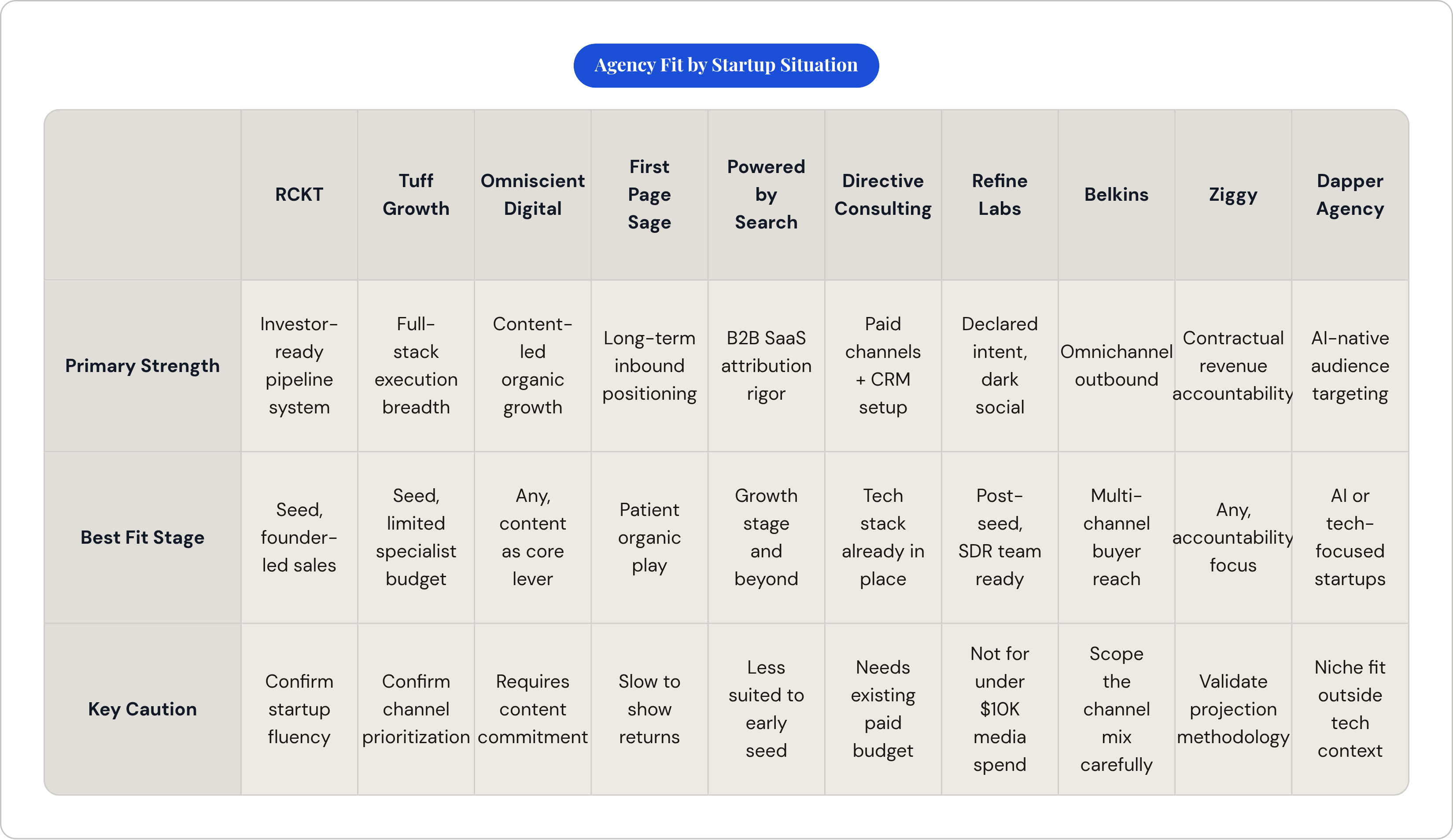
Dapper Agency uses AI to help products reach the right audience and was built for startups and tech-focused businesses. If you're operating in an AI-native context, their workflow will feel familiar.
One thing worth saying plainly: agency fit changes as you grow. The right partner at $500K ARR is rarely the right partner at $3M ARR. That's not a failure on anyone's part. That's just how stage-appropriate vendors work.
How to run the agency evaluation process without wasting weeks on it
Before reaching out to anyone, get clear on three internal questions:
- What motion do you actually need: inbound-heavy, outbound-heavy, ABM, or some integrated mix?
- What budget can you commit for six to twelve months?
- What can your CRM actually track today?
Run a shortlist of three to five agencies. Not ten. The evaluation itself takes real time, and most founders underestimate that cost until they're two weeks in and talking to their seventh agency, wondering how it got to this.
The questions that separate startup-fluent agencies from everyone else
Ask every agency on your list:
- "What does your engagement look like with a company under $2M ARR doing founder-led sales?"
- "How do you define success in the first 90 days, and how does that connect to what an investor wants to see at 12 months?"
- "Walk me through how you'd report on CAC and pipeline velocity for a seed-stage client."
- "What channels would you avoid running for us right now, and why?"
That last question is the most revealing one. Agencies that recommend everything reveal they're not thinking about your stage. Agencies that push back and explain the tradeoffs are actually thinking about your situation. That distinction matters more than anything else in the conversation.
Red flags that end the conversation early
- They lead with impressions, traffic, or marketing-influenced revenue before mentioning pipeline
- They recommend a channel mix that doesn't match your ARR stage
- They can't name startup clients they've worked with or won't share what those clients achieved
- The proposal is a strategy document with no operational detail
Green flags worth paying attention to
- They ask about your ICP before pitching any channel
- They name the metrics your next investor will ask about and explain how they plan to build toward them
- They can describe specific playbooks they've run for startups at your exact stage, not just adjacent ones
A note on the build-vs-hire question: a full-time marketing hire costs $120,000 to $180,000 or more fully loaded and covers one discipline. A specialist growth partner brings a team of senior generalists, moves faster because they've already built the playbooks, and typically costs less. The math usually favors the agency until the system is built. Hire in-house after that, not before.
What a demand gen agency should help you build toward before Series A
The output of a well-run demand gen engagement is not a set of campaign assets. It's a documented, repeatable pipeline system with metrics that hold up in a due diligence conversation. Investors have seen enough polished decks. They want the numbers.
The bar for a competitive Series A raise has moved. The median Series A now requires roughly $2.5M in ARR, up significantly from just a few years ago. Only about a third of seed-funded companies successfully raise a Series A, and marketing problems are the second leading cause of startup failure, sitting right behind lack of product-market fit. That context matters when you're deciding what your demand gen program actually needs to produce.
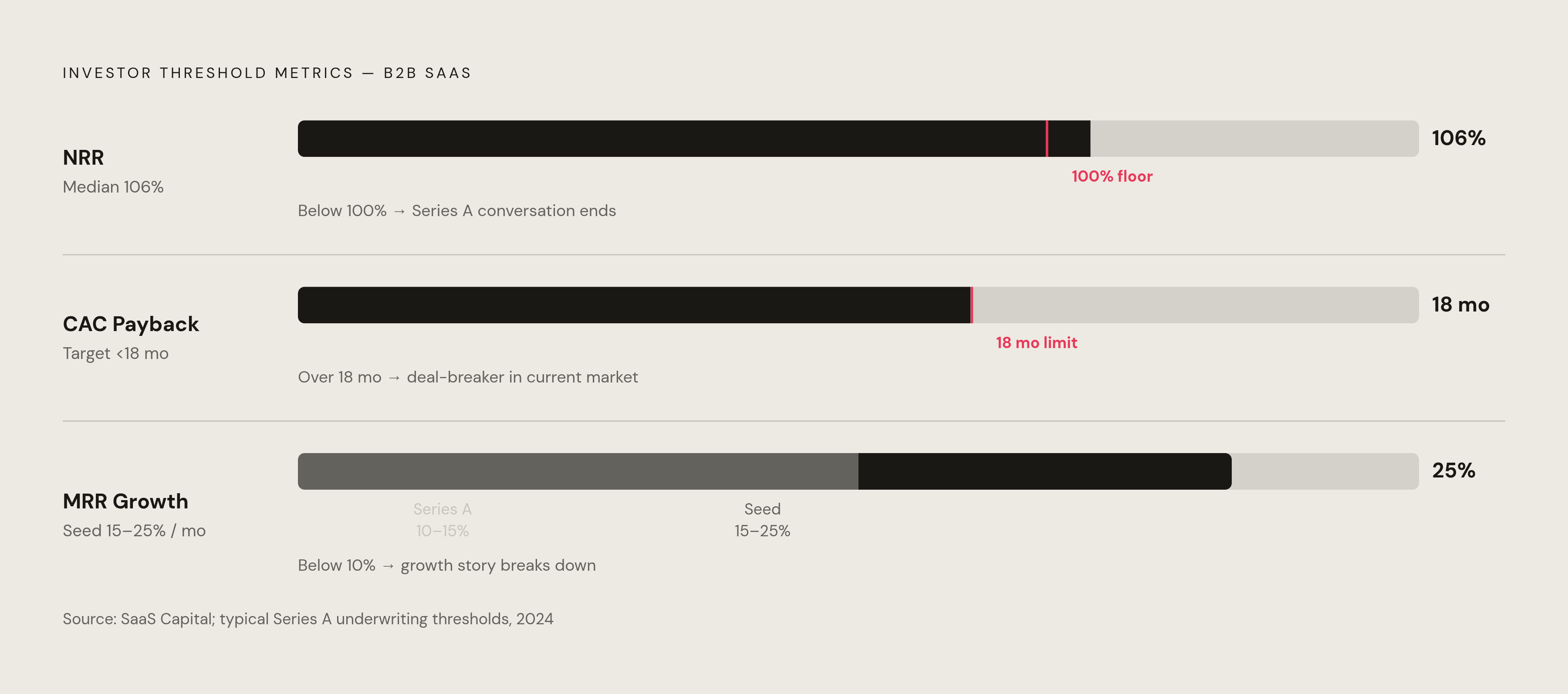
These are the metrics investors will actually interrogate:
- NRR: The median for venture-backed B2B SaaS companies sits around 106%, per SaaS Capital's benchmarks. Below 100% ends most Series A conversations regardless of ARR growth.
- CAC payback: Over 18 months is a deal-breaker in the current market. Customer acquisition costs have been climbing, which means expansion revenue from existing customers is now the most efficient growth path available to most startups.
- MRR growth rate: Seed-stage startups should target 15 to 25% month-over-month. Series A companies typically run at 10 to 15%.
Including specific growth metrics in fundraising materials meaningfully increases investor response rates. Traction, to an investor, is not activity. It's evidence of a repeatable system.
That's the thing you're actually hiring a demand gen agency to help you build. Not traffic reports you have to translate into a pitch. Not brand campaigns that need two quarters to show anything. The engine that produces the evidence. When you're evaluating agencies, that's the frame to keep: not who has the best logo or the nicest deck, but who can build what you need to prove before that Series A conversation happens.