Growth Marketing Agencies for Early-Stage Startups

Picking the wrong growth marketing agency at seed stage doesn't just cost you money. It costs you months. And at seed stage, months are the thing you have the least of.
Here's the uncomfortable truth: most agencies that say they work with startups were actually built for companies that already figured out their growth motion. They're optimized for Series B and beyond. Predictable budgets. Proven channels. Clear brand guidelines. A founder who just closed a $1.5M seed round, has no marketing hire, and is still running every sales call personally? That's a completely different problem. And most agencies are not actually equipped to solve it.
The global startup market is enormous, new companies launching every year in the millions, but the failure rate is unforgiving. A meaningful chunk of those failures trace back to wrong marketing strategy, not bad product. And a sub-market of agencies has grown up claiming to serve this space. "Startup-friendly" sounds great. It's also a positioning claim, not a capability guarantee. Almost every roundup you'll find of the "best growth agencies for startups" was written by one of the agencies on it. Read those sources accordingly.
What follows is a framework for evaluating fit at your specific stage. Not a ranked list of logos. A way to think clearly before you sign anything.
What a seed-stage startup actually needs from a marketing partner right now
Seed stage is not scale stage. The job isn't to pour fuel on a fire. It's to find the fire first — and finding that fire is less like flicking a lighter and more like rubbing two sticks together in the dark: slow, uncertain, and completely necessary before anything else catches.
If you've closed enough deals to start seeing patterns, you have real signal. You know something about who closes fastest, which objections keep showing up, and which channels produced something real versus which ones just felt productive. Now the work shifts. You're building process around what's working. Your messaging needs to sharpen because buyers are now comparing you against real alternatives.
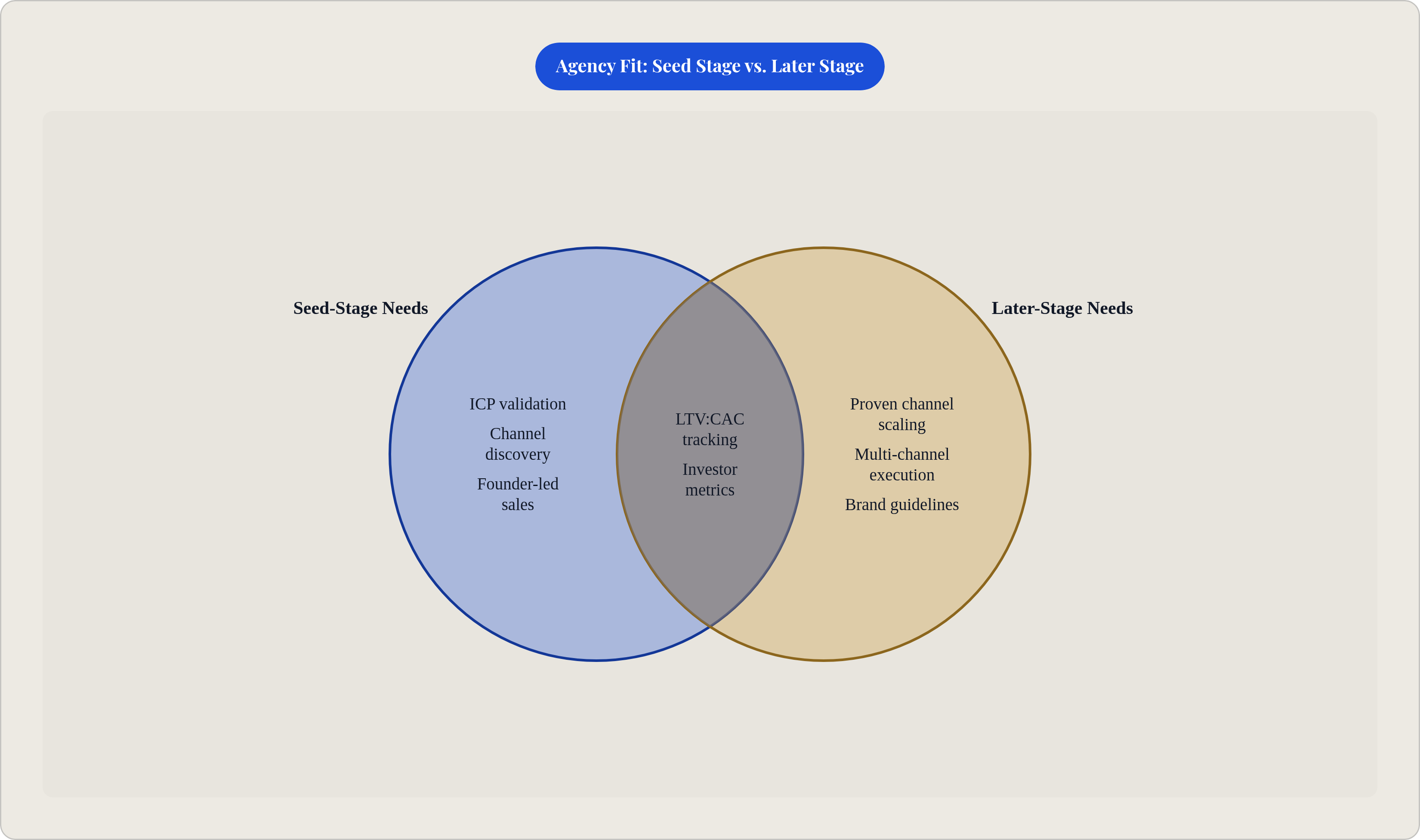
The three things a seed-stage founder actually needs from an agency:
- ICP clarity and positioning that converts. Not a brand exercise. A conversion instrument. Who is the buyer, what do they need to believe, and what does a message that moves them look like?
- A short list of channels worth testing. Not a full-funnel build-out. Given your ICP, which one or two channels deserve a real experiment right now?
- Investor-grade metrics built in from day one. CAC by channel. Pipeline velocity. MQL-to-customer conversion. LTV:CAC. These can't be retrofitted six months before your Series A pitch. They need to be running from the start.
Series A investors in 2025 expect somewhere in the range of $1–3M ARR, strong year-over-year growth, and an LTV:CAC ratio of at least 3:1. The marketing engine you build at seed needs to be producing evidence for those benchmarks, not just generating activity.
The average time between a $1M+ seed round and Series A has stretched to over two years. That's the actual runway for building a growth story. It shapes everything about what kind of agency engagement makes sense.
The most common mistake founders make? Hiring an agency to do what they're already doing (running ads, publishing content) rather than to solve the upstream problem. Unclear ICP. Unproven channel. Messaging that doesn't convert. You can have perfectly executed tactics aimed at the wrong target, and you'll get nothing back except a thinner bank account and a ticking clock.
Founder-led sales is a starting point, not a growth strategy. The right agency partner helps you systematize what you've already learned from direct selling. They do not replace those lessons with a generic playbook that worked for someone else's business.
The four agency archetypes and where each one breaks down for early-stage founders
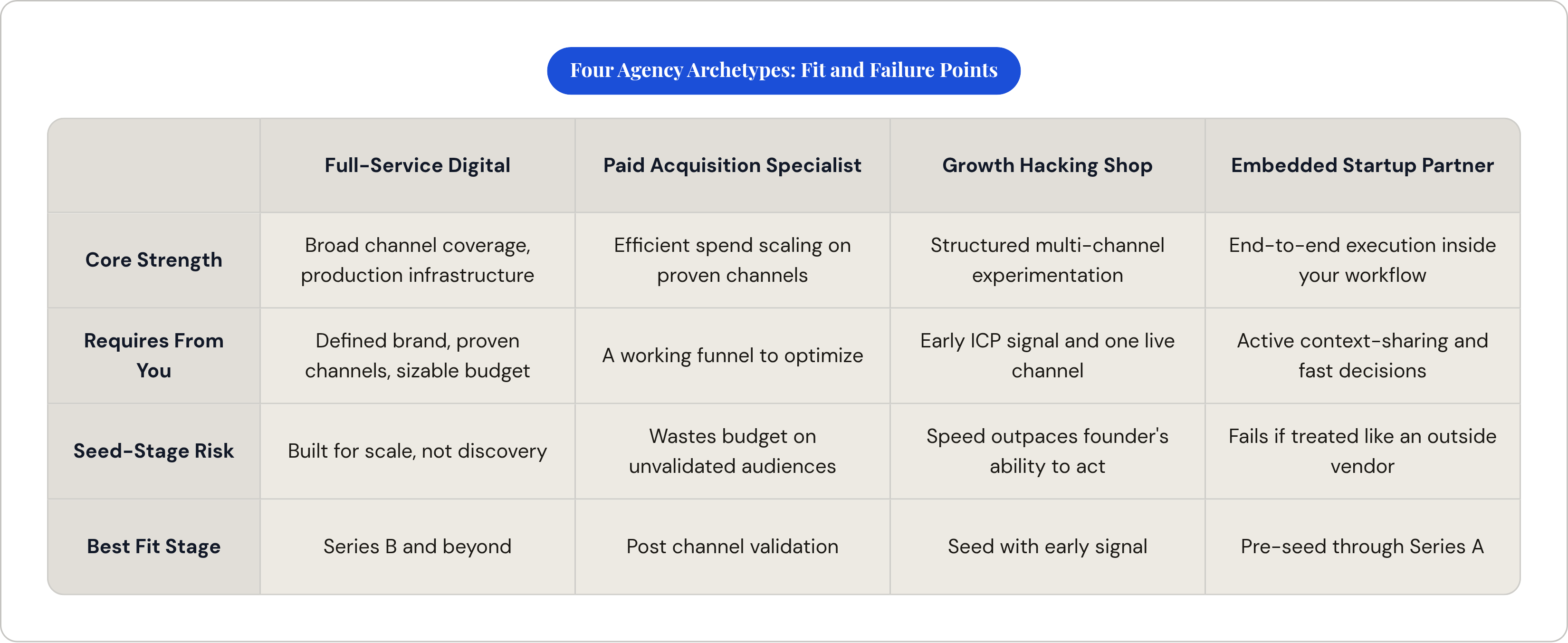
There are four recognizable types of growth agencies in the market. Each has a legitimate use case. None of them is right for everyone. Here's how to think about each one honestly.
Archetype 1: The traditional full-service digital agency
These shops have broad channel coverage, established production processes, and experience working across brand and performance. They've been around long enough to have real infrastructure.
Where they break down for you: they're optimized for clients who already have defined brand guidelines, proven channels, and enough budget to run multiple workstreams at the same time. Seed-stage founders have none of those things. The tell is in their onboarding. If they ask for a brand bible and a six-month content calendar before they've validated a single message, they've already shown you who they were built for. It wasn't you.
Archetype 2: The performance and paid acquisition specialist
Paid social and search specialists can move fast. When a channel is proven, they're genuinely good at scaling spend efficiently. That's a real skill.
The problem at seed stage is the word "proven." Paid acquisition on an unvalidated ICP and untested message doesn't produce results. It produces data you don't know how to interpret, and a shrinking budget. These agencies need a working funnel to optimize, not a hypothesis to test. Boutique paid-only retainers run roughly $2,000–$10,000 per month. That's accessible for a seed budget. But cheap paid execution aimed at the wrong audience is still waste, just affordable waste. You could call it a bargain — but so is a map to the wrong destination.
Archetype 3: The growth hacking and experimentation shop
These agencies run structured channel experiments, often with multi-specialist teams that combine technical, product, and marketing expertise. GrowthRocks is a well-known example of this model. They can help a founder find second and third channels once there's early signal on the first.
They fit best when you already have enough ICP signal and at least one channel showing early results. Where they break down: experimentation without a clear ICP hypothesis is just activity with a spreadsheet attached. Some of these shops also run tests faster than a seed-stage founder can actually absorb and act on the implications. Speed is only useful if you're ready to move with it.
Archetype 4: The embedded startup growth partner
This model is the one designed specifically for the constraints of seed stage. The agency operates inside your workflow. They know your product roadmap. They execute across positioning and channels end-to-end and adapt in real time. Rather than handing you a strategy deck and billing monthly, they function more like part of the team.
Growth Division is a named example of this model. They embed growth and sales talent into pre-seed through Series A companies building their first growth motion. When there's no internal marketing team and no proven playbook, this kind of embedded relationship can fill a gap that a traditional retainer never will.
Where it breaks down: it requires a founder who actually shares context and makes fast decisions. Passive clients don't get the benefit of the embedded model. If you hire a partner to be inside the business and then treat them like an outside vendor, you've defeated the purpose.
A fifth type worth knowing: AI-native agencies
A growing number of boutique shops, including at least one early YC-backed example, are optimizing specifically for visibility inside AI assistants like ChatGPT and Perplexity rather than traditional search. The thesis is narrow but legitimate. If your customers are already discovering vendors by asking an AI, ranking in those responses matters.
That said, this is too specialized to be a primary growth partner at seed stage. It's a layer of a broader strategy, not the strategy itself. Worth knowing exists. Not worth betting the runway on.
How to evaluate an agency's actual fit before signing anything
The right framework for evaluation isn't about who has the best website or the longest client list. It's about five specific filters.
Filter one: do they start with ICP or with channel?
An agency that leads with "we'll run your paid social and SEO" before asking who your buyer is has already told you how they work. They execute tactics into a vacuum.
The right agency starts by interrogating the ICP. Who closes fastest? Why did the last three deals stall? What does the champion say versus the economic buyer? LinkedIn's own 2025 campaign data found that ICP-targeted campaigns produce 68% higher ROI than broad targeting. The agency that skips ICP work is skipping the highest-leverage step available to them. That's a choice, and it's a revealing one.
Filter two: what do their startup case studies actually show?
Look for documented, specific outcomes. Revenue growth rates. User acquisition numbers. Funding milestones. Not client logos and vague "growth" language.
Ask these three questions directly: what stage was the client when you started, what was the ICP when you started, and how did it change? Agencies with genuine seed-stage experience will have a clear answer about ICP pivots. They'll probably have a story about the time the hypothesis was wrong. Agencies that mostly work with later-stage companies won't think to mention pivots at all, because their clients didn't need to do that work.
Filter three: how do they structure the first 90 days?
Most legitimate startup-focused engagements need at least three to six months to show meaningful results. An agency promising results in 30 days on unvalidated channels is selling, not planning.
A credible first 90 days should include an ICP and positioning audit, identification of one or two channels worth running structured experiments on, and the establishment of baseline metrics that will feed your investor narrative. Ask specifically: what decisions will you help me make by day 90, and what will you need from me to make them? The quality of the answer tells you a lot.
Filter four: do they have a real answer for measurement?
You need investor-grade metrics from the start. CAC by channel. Pipeline velocity. LTV:CAC. Not traffic. Not impressions. Not engagement rate.
Ask directly: how do you attribute pipeline to specific campaigns, and what does your reporting look like at month three? Agencies that can't answer this concretely will produce activity metrics. Activity metrics don't compound into a Series A story. They just fill a slide that no investor cares about.
Filter five: what's their model on AI search?
Demand Curve has launched a dedicated practice for AI search visibility. That's a signal. Credible agencies are already integrating this into their thinking, not treating it as something to figure out later.
A useful signal question: how do you think about visibility in AI assistants alongside traditional SEO, and what are you doing for clients today? It's not a disqualifier if they're still building a position here. It is a red flag if they're completely dismissive. AI-assisted discovery is already shifting B2B buyer behavior. An agency that isn't paying attention to that is an agency that isn't paying attention.
Pricing structures and what they reveal about agency fit
Price matters, but how an agency prices reveals more than what they charge.
The three live pricing tiers
- Boutique or single-channel: $2,000–$10,000/month. Accessible for seed budgets. Right for a founder who needs one channel executed well while they focus elsewhere. Not right if you need strategic direction along with execution.
- Mid-market multi-channel: $10,000–$50,000/month. This is the Series A to C range. You have a proven motion and you're scaling it across channels simultaneously. Not where most seed-stage founders should be spending.
- Fractional growth leadership: $15,000–$30,000/month. This fills a leadership gap, not an execution gap. Right when the problem is strategic direction from someone who's done it before. Not right when you need hands-on delivery.
What the structure itself tells you
A fixed retainer with no performance component means the agency gets paid regardless of whether they find a channel that works. That misaligns incentives at the exact stage where channel validation is the entire job.
Revenue-tied or milestone-tied components signal the agency is willing to sign up for outcomes, not just activity. The best agencies are starting to structure this way. It's a green flag.
Project-based pricing for positioning and ICP work is legitimate, and often the right starting point. It lets you evaluate the quality of thinking before committing to a full retainer. You learn whether they can actually do the upstream work before you pay for months of downstream execution.
A practical budget frame
If your total marketing budget is $10,000–$15,000 per month, an agency taking $5,000–$8,000 of it needs to be producing direct pipeline signal. Not brand awareness. Not content output. Pipeline signal. The math only works if the engagement is tied to measurable acquisition activity.
Watch for agencies that price at the low end but scope the work broadly. "We'll handle all your marketing" at $3,000 per month is either a part-time assistant or an offshore content operation. Neither one builds a growth engine.
The questions worth asking before the first call ends
These aren't gotcha questions. They're designed to surface how an agency actually thinks, which is the thing you're really buying.
On ICP and positioning:
- "Walk me through how you'd validate or challenge our current ICP hypothesis in the first 30 days."
- "Have you worked with a company at our stage that had to pivot their ICP? What happened?"
On experimentation and channel selection:
- "What channels would you not recommend testing at our stage, and why?"
- "How do you run a structured channel experiment? What does the test look like, what data ends the experiment, and what does a 'no' look like?"
On the investor narrative:
- "What metrics will your work produce that I can put in a Series A deck in 18 months?"
- "How do you think about CAC and LTV:CAC? Are those numbers you track and report, or does that live on our side?"
On the working relationship:
- "What do you need from me, specifically how often and in what form, for this engagement to work?"
- "What does a founder do that most often causes an engagement like this to underperform?"
On results and accountability:
- "Show me a case study where you worked with a seed-stage company that had no proven channel when you started. What did you find, how long did it take, and what's a realistic outcome for us?"
- If the answer is a vague success story with no specific numbers or timeline, that's your answer.
The underlying point is this: you're not buying services. You're buying a thinking partner who will be embedded in your most important operational challenge for the next 12–18 months. The questions that reveal how an agency thinks matter more than any case study deck they email you the night before the call.
A bad agency engagement at seed stage doesn't just drain the marketing budget. It burns the months you needed to build a real traction story. Ask the hard questions early. The right partner won't flinch at them.