Performance Marketing Agencies for B2B Startups
Validate your messaging through cheap channels before spending on paid ads.

Let's start with a definition, because "performance" gets stretched into meaninglessness pretty fast.
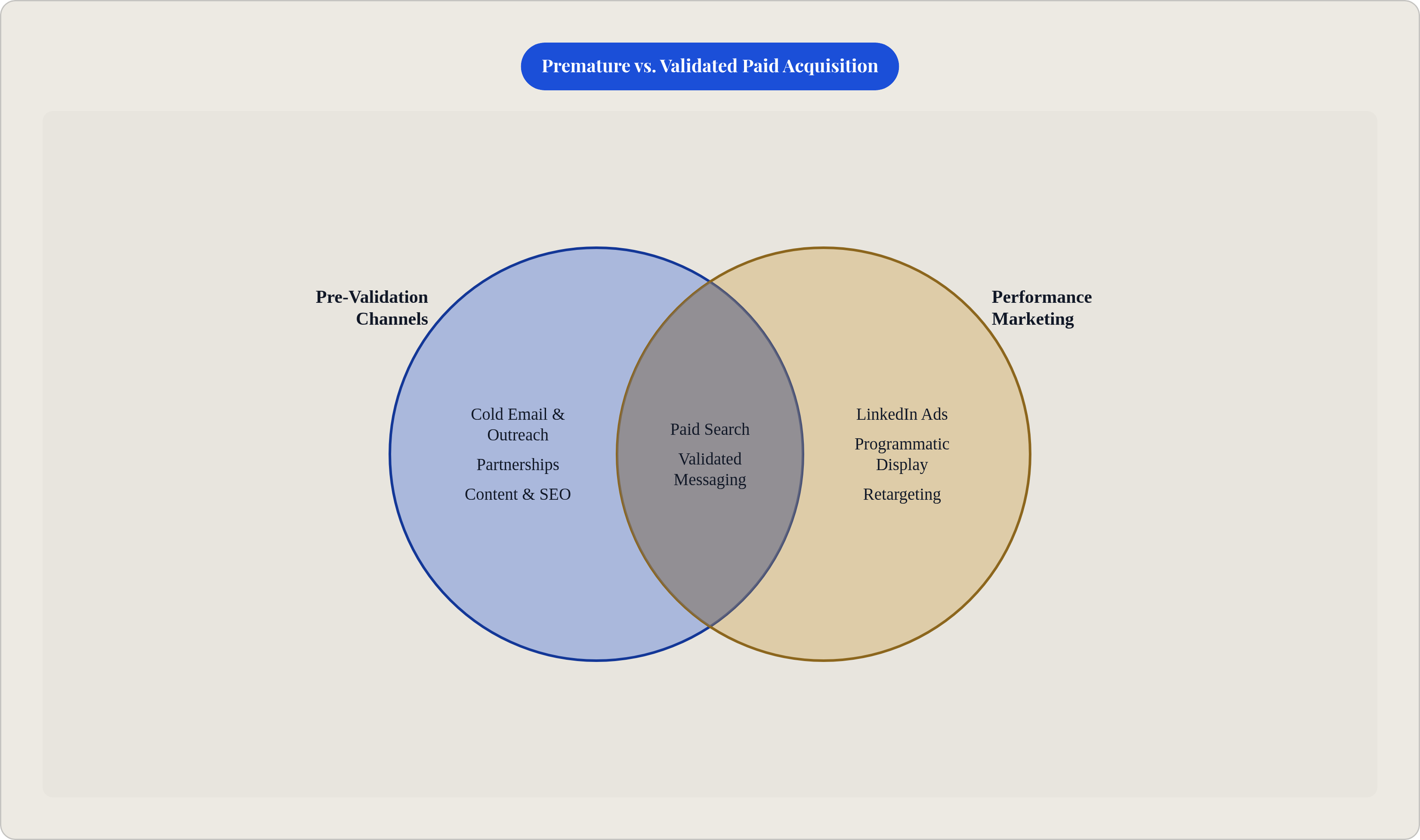
A performance marketing agency runs paid, measurable acquisition channels. Paid search (Google, Bing), LinkedIn Ads, Meta, programmatic display, retargeting. The defining feature is accountability to outcomes. Not deliverables. Outcomes.
A content agency delivers blog posts. A performance agency delivers attributed pipeline. That's the distinction. In theory, anyway.
In practice, "performance marketing" has become a label agencies slap on any digital marketing that includes a tracking pixel. So when you're evaluating agencies, the first thing to probe is simple: what metric is the agency actually held to? Impressions? Leads? Meetings booked? Closed revenue? The answer tells you everything.
Here's what a B2B performance agency typically covers:
- Paid search. Capturing people already searching for what you do. High intent, lower volume in most B2B niches.
- LinkedIn Ads. The primary paid channel for most B2B companies. Expensive and worth it when the ICP is tight.
- Retargeting. Staying visible to visitors who didn't convert the first time. More useful once you have meaningful site traffic.
- Landing page and conversion rate optimization. Making the click actually do something.
- Attribution modeling. Connecting spend to pipeline and, ideally, to closed revenue.
Here's what they typically do NOT do: foundational positioning, ICP definition, messaging strategy, content creation, sales enablement. That upstream work is yours to bring. The agency builds on top of it.
This is the gap that hurts seed-stage founders most. If you bring in a performance agency before that upstream work is done, the agency isn't running paid campaigns. They're running expensive guesses. Like a GPS giving perfect turn-by-turn directions to the wrong destination.
The Sequencing Problem: When Paid Performance Spend Is Actually Premature
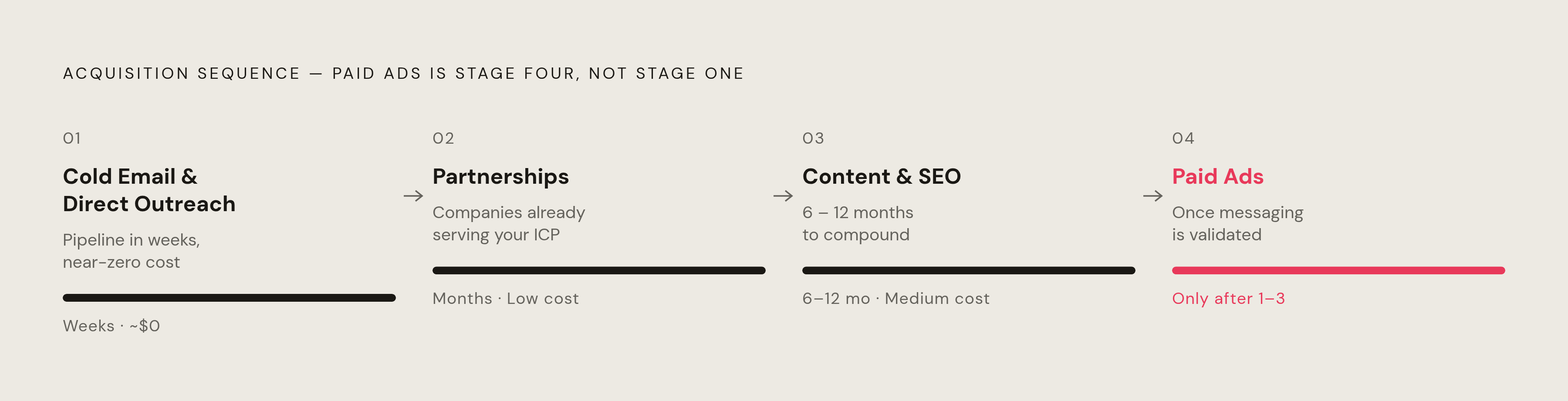
The most common mistake isn't picking the wrong agency. It's running paid acquisition before you've validated your messaging through cheaper, faster channels.
Research on early-stage B2B startups consistently shows that personal sales should precede paid marketing. The basic finding is that shifting budget toward direct outreach in early stages can dramatically lift revenue, while the equivalent shift toward paid only pays off after product-market fit is established. The sequence matters more than the tactic. That's not a small point.
The channel order that actually makes sense before heavy paid investment:
- Cold email and direct outreach. Pipeline in weeks at near-zero cost. More importantly, you get real objections, real language, and real signal on whether your positioning lands.
- Partnerships. Find companies already serving your ICP. Underused and underrated at seed stage.
- Content and SEO. Longer payoff, six to twelve months to compound, but it builds an asset you own.
- Paid ads. Once messaging is validated and you have proof points to put in the creative.
Paid ads are an amplifier. They amplify what's already working. They do not discover what works. It's a megaphone: it makes your voice louder, but if you're saying the wrong thing, more people just hear you say the wrong thing.
A useful reality check on budget: most seed-stage B2B SaaS startups should allocate somewhere between $5,000 and $15,000 per month on marketing total. That's enough to run one or two channels seriously. It is not enough to fund a full agency retainer plus ad spend without being very deliberate about where the money goes.
The exception worth naming: if you already have your first ten to fifteen customers, you know exactly who they are, and your messaging is validated through real sales conversations, you can unlock paid earlier. But even then, you're amplifying a proven signal. Not fishing blind.
If an agency pitches you on paid social as the first move without asking about your current pipeline, your close rate, or what messaging has already landed with buyers, that's not a proposal. That's a warning sign.
Why ICP Clarity Is a Prerequisite for Performance Marketing, Not a Parallel Workstream
This one comes up constantly, and it always surprises founders how much it matters.
ICP clarity isn't a nice-to-have you develop alongside your paid campaigns. It is the input the campaigns run on. Without it, the agency is just burning money more efficiently.
ICP clarity in a B2B context isn't just a market you want to serve. It's the specific segment that converts and renews. That means firmographics (industry, company size, tech stack), but it also means trigger events, buying process, and decision-making structure.
Here's why that specificity matters for paid specifically. LinkedIn Ads targeting is only as precise as what you tell it. A campaign targeting "VP of Sales at SaaS companies" is a demographic, not a strategy. Without knowing the trigger event, the pain, and where this person is in the buying process, you're reaching people who fit the profile but won't convert.
There's also the multi-stakeholder reality of B2B buying. Modern B2B deals routinely involve six to ten stakeholders. Forrester research puts over 60% of B2B purchases at four or more decision-makers from different departments. A performance agency needs to know which persona they're targeting at which stage of the funnel, or the spend gets spread thin across people who matter but aren't the right people right now.
Also worth keeping in mind: only around 5% of B2B buyers are in-market at any given time. You're not reaching a huge pool of ready-to-buy prospects. You're finding a very small, specific group. That only works if you know exactly who you're looking for.
Before you engage a performance agency, you should have:
- A defined ICP with firmographics AND trigger events. Not just company size and industry.
- Clarity on the buying committee: economic buyer, technical buyer, champion.
- Messaging that speaks to outcomes, not features. "Three hours saved per manager per week" rather than "report automation tool."
- At least some validation from real sales conversations that the pain is real and your framing resonates.
If you can't brief an agency on who you're targeting and why they buy, the agency cannot fix that gap with targeting tools. They'll just optimize against the wrong inputs faster.
What Separates Performance Agencies That Build Pipeline From Those That Optimize for Activity Metrics
Let's talk about the activity trap, because it's where a lot of agency relationships go sideways.
An agency's job is, in part, to justify its retainer. The easiest way to do that is with metrics that look good, are easy to hit, and are easy to attribute to the agency's work. Impressions. Clicks. CTR. MQL volume. These are real numbers. They just often have nothing to do with revenue.
A pipeline-oriented agency tracks different things:
- CAC by channel. Not blended. By channel. So you can cut what doesn't work.
- Pipeline velocity. Time to first meeting. Stage-to-stage conversion rates. Sales cycle length.
- MQL-to-SQL conversion rate. This is where most B2B funnels leak, and where agency-sourced leads most often underperform.
- LTV:CAC ratio. The floor you want to see is 3:1. Below that, you're subsidizing your own customers.
- CAC payback period. The rough rule is twelve months or less for SMB, eighteen months or less for mid-market.
Customer acquisition costs have been climbing steadily. The efficiency pressure is real. Agencies that don't obsess over payback period are working against the macro environment you're in.
Here's how to read an agency in the pitch before you've signed anything.
Signs they're probably worth talking to:
- They ask about your sales cycle and average deal size before proposing a channel mix.
- They propose being held to SQLs or pipeline value, not just leads delivered.
- They ask how closed-won data will flow back to them for optimization.
- They scope a testing phase before a full retainer.
Signs to be cautious:
- Pitches that lead with channel capabilities rather than your specific ICP and stage.
- Guarantees on lead volume without asking about your sales process or close rate.
- Reporting dashboards that stop at MQL with no visibility into what happens after the lead handoff.
- No ask about what you've already tried or what messaging has landed in actual sales conversations.
The cautionary signs aren't about incompetence. They're about misalignment. An agency optimizing for MQL delivery is doing its job. It's just not doing your job.
The Specific Qualities to Look For When Evaluating Agencies as a Seed-Stage Founder
Stage fit matters more than channel expertise. An agency with deep LinkedIn Ads experience serving Series C enterprise companies is not automatically a fit for a seed-stage startup with unproven messaging and an $8,000/month budget. That agency's playbook was built for a company that already has validated messaging, proven channels, and enough conversion data to optimize against. Applied to your stage, it backfires.
What to actually evaluate:
Portfolio and references. Have they worked with companies at your stage, in your category, with your budget range? Not just your industry. Stage and budget matter as much as vertical fit.
How they handle the pre-campaign phase. Do they do positioning and messaging work, or do they assume you walk in with everything ready? If it's the latter, find out who's doing that work. Someone has to.
Willingness to work with small initial budgets. Agencies that require $20,000 or more per month in ad spend minimums are built for companies that have already proven the channel. That is not you yet.
Whether they build the system or just run campaigns. There's a real difference between an agency that hands you a monthly dashboard and one that trains your team, documents their playbook, and builds automations you actually own. The former is a vendor relationship. The latter is leverage.
The full-stack versus specialist question. A specialist paid social agency is often excellent at LinkedIn Ads but completely blind to whether the offer itself is converting. The founder ends up managing the gap between agency work and positioning work. Exhausting and expensive. An embedded growth partner who covers positioning through execution catches those gaps in real time instead of at the end-of-month report.
One more thing worth saying plainly: depth over breadth. Running eight channels at half effort produces less than two channels at full focus. An agency that proposes a five-channel launch plan for a seed startup is optimizing for their scope of work, not your results.
Questions worth asking in the pitch:
- "What would you need from us before you'd be confident running paid campaigns?"
- "How do you connect what you're running to pipeline, not just leads?"
- "What does your reporting look like at 30, 60, and 90 days?"
- "Have you worked with companies at our stage and budget before? Can we talk to one of them?"
The answers to those four questions will tell you more than the deck.
How Performance Marketing Should Connect to the Metrics That Matter at a Series A Raise
Here's the context that makes all of this feel urgent rather than abstract.
Only about a third of seed-funded companies successfully raise a Series A. The ones that do have demonstrated repeatable, attributable pipeline growth. Not just revenue. Repeatable, attributable pipeline growth. Those words matter individually.
What investors actually want to see from marketing at this stage:
- CAC that is improving or at least stable as you scale spend. Rising CAC with rising spend is a problem. It means you've picked the low-hanging fruit and the channel isn't scaling efficiently.
- Pipeline velocity. Evidence your GTM motion is shortening, not lengthening, the sales cycle.
- Channel concentration risk. Are you dependent on one founder relationship or one paid channel, or is there a diversified, systematized motion?
- Cohort data. MQL-to-customer conversion rates over time, showing the funnel is tightening.
Here's the catch: you cannot retrofit this. These metrics have to be built into the marketing system from day one. Spend twelve months running campaigns without closed-loop attribution, and you cannot tell investors a credible CAC story. You just have a number you can't defend.
This is what makes agency selection a strategic decision rather than a procurement decision. The right performance agency doesn't just run your campaigns. It builds the reporting infrastructure that lets you tell the growth story. UTM structures, CRM integration, closed-loop reporting from ad click to closed revenue, monthly reporting framed around investor metrics rather than agency activity metrics.
Content and SEO build durable assets. Performance marketing builds the data set that tells the traction story. Both have a role. But if you're heading into a Series A raise, the data set needs to be clean, attributed, and moving in the right direction.
Pick the agency that understands that's what it's actually building.