Go-to-Market Consulting Firms for Early-Stage Startups
Seed-stage startups need execution partners, not scale advisors.

At seed stage, you are not optimizing a funnel. You do not have a funnel. You are trying to figure out who your customer actually is, what they care about, and whether your problem is painful enough that someone will actually pay you to fix it. That is discovery work. Not scaling work. And most GTM firms were not built for discovery.
They were built for scale. They assume you already know your ICP, your channel mix, your unit economics. Hand one of those firms a seed-stage problem and the advice you get back is calibrated for a company with a multi-million dollar marketing budget. It does not just miss the mark. It points you in the wrong direction with a lot of confidence.
So what do you actually need? A few things, none of them complicated:
- A generalist who can run experiments, not a channel specialist who optimizes one thing. Specialists are great when you know what to optimize. You do not know that yet.
- ICP definition before channel selection. This is the order of operations most firms reverse. Broad ICP produces generic messaging, wasted targeting, and sales cycles that just kind of trail off. Nail the audience first. Channel is a downstream decision.
- Positioning that narrows, uncomfortably so. One problem, one audience, one differentiator. The instinct to stay broad so you do not "leave anyone out" is exactly the instinct that kills early messaging.
- Two channels, not five. Small budgets spread thin produce no real data. Pick two, run them hard, and actually learn something.
- Metrics from day one. CAC, pipeline velocity, MQL-to-customer conversion. Not retrofitted later when an investor asks why you cannot explain your own acquisition numbers.
Paul Graham has a line about doing things that do not scale. That is basically the whole seed-stage GTM job. You are hand-cranking the engine to see if it runs before you wire it to anything automated. The firm you hire needs to be willing to turn the crank with you, rather than just describe what the engine looks like at full speed.
The fractional CMO model maps well to this for one practical reason: experienced leadership without the cost of a full-time C-level hire, and someone whose job is execution rather than advisory. That alignment between budget and actual need is why fractional GTM has grown into its own category.
The Strategy-Deck Problem and What Execution-First Engagement Actually Looks Like
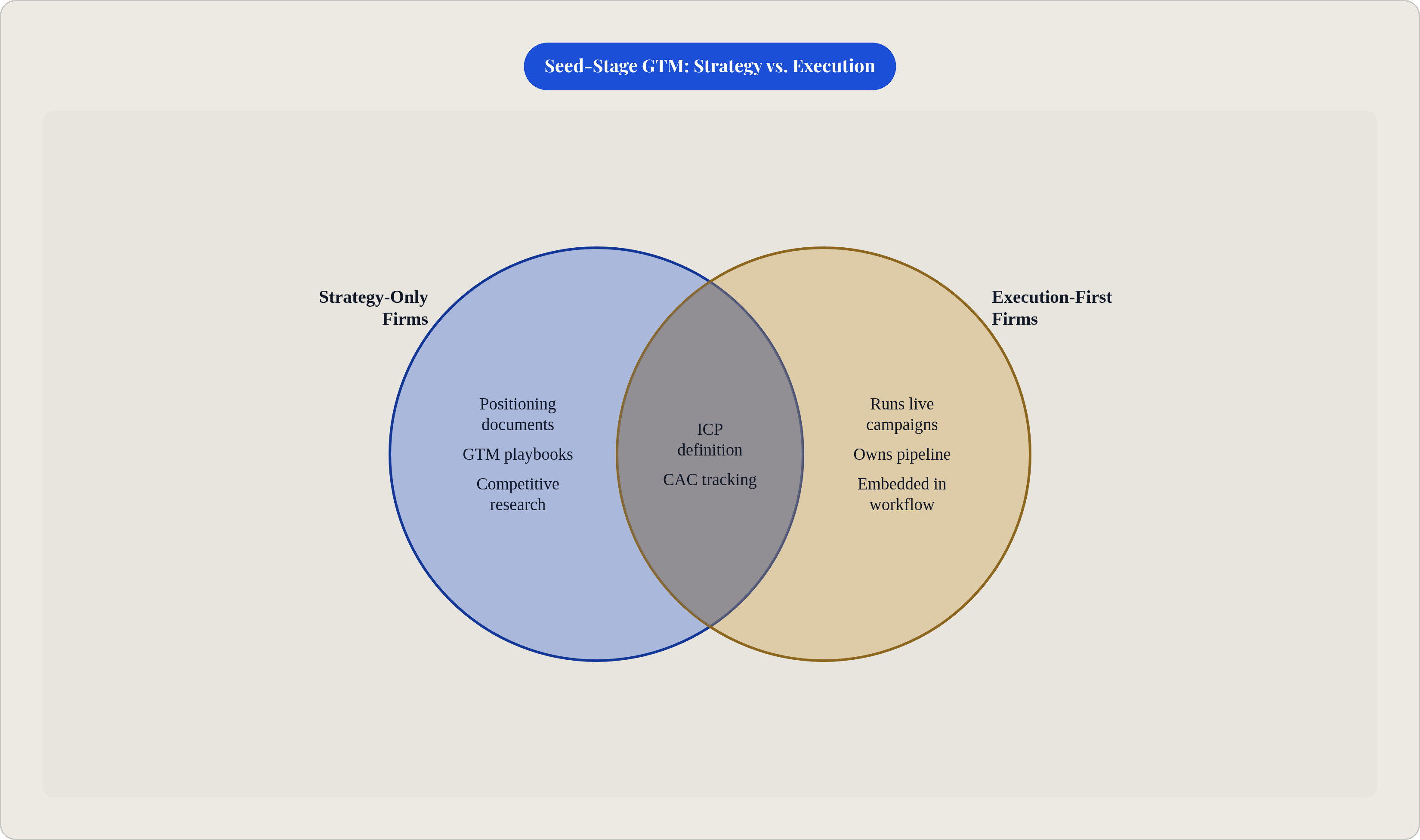
This failure mode follows a pattern so predictable it should have a name.
A firm takes a founder's money. They interview the team, do some competitive research, run a few customer discovery calls. Six weeks later, they deliver a polished positioning document and a GTM playbook. Then they leave. The founder is holding a strategy they did not build and do not fully believe, with no clear path from the document to actual pipeline.
A strategy deck has no feedback loop. It cannot tell you whether the ICP was right. It cannot tell you whether the message converted. It is a hypothesis written in a font that makes it look like a conclusion.
Execution-first engagement looks different in practice, not just in how it is described on a sales call:
- Embedded in your workflow. Slack access, product visibility, weekly iteration cycles. Not a monthly check-in Zoom.
- Owns pipeline, not page count. The measure of success is whether deals are moving, not whether the document is thorough.
- Actually runs campaigns. Writes copy, adjusts targeting, reports on what the data showed and what changes next week.
- Builds something you can hand off. When the engagement ends and you hire your first in-house marketing leader, that person can pick up what the firm built. It is not locked inside a proprietary methodology that only makes sense if you keep paying them.
There is also a timing issue worth thinking through. The growth-at-all-costs philosophy that defined GTM a few years ago is not what investors want to see in 2025. Capital efficiency and net retention matter more than acquisition velocity right now. A GTM partner still chasing volume metrics is not just behind the times. That partner is misaligned with what your next raise will actually require.
Before you sign with anyone, ask them what the engagement looks like in month two. What are they running? What are they measuring? How does that change based on what the data shows? That question alone tells you most of what you need to know.
How the Major GTM Firm Categories Map to Founder Needs at Seed Stage
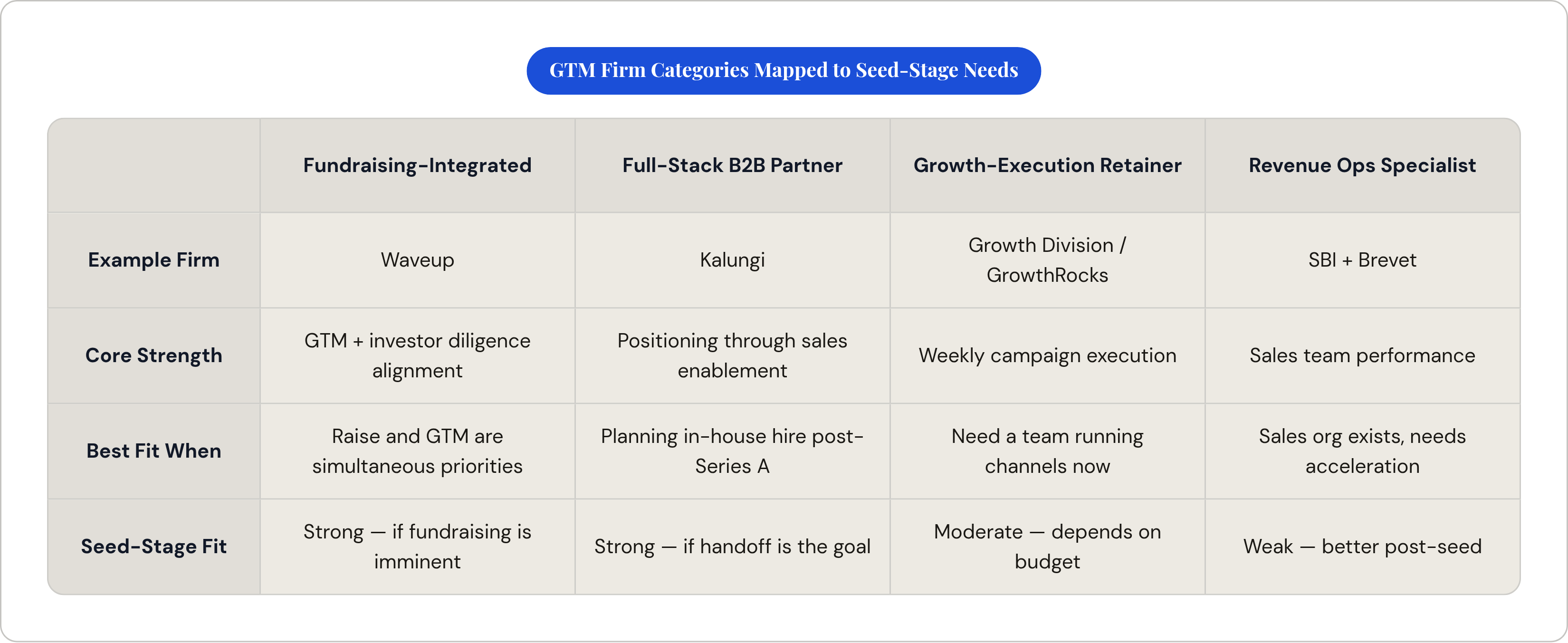
The GTM consulting landscape looks chaotic until you understand the categories. The problem is that most firms do not advertise which category they actually live in, which means you have to figure it out yourself.
Fundraising-integrated GTM advisors build GTM strategy with investor diligence baked in. They understand that your market plan has to survive a VC pitch, not just customer conversations. Waveup fits here. They have worked with more than 600 startups and have been involved in raising over $3 billion across that portfolio, with GTM strategy sitting alongside pitch work and VC intro networks.
Full-stack B2B marketing partners handle positioning through sales enablement, end to end, with the explicit goal of handing off a running engine. Kalungi fits here. They focus on B2B SaaS companies scaling from first revenue toward meaningful ARR, and their model is oriented around building something the founder eventually owns internally.
Growth-execution retainers put a full growth team on retainer to run campaigns and channels week to week. Growth Division fits here. They work with more than 130 startups across the UK, US, and Europe, with named clients including Oddbox, SeedLegals, and Stability.ai, running at roughly £5,000 to £10,000 per month. GrowthRocks also fits this category, and their GrowthBites option is specifically for startups not yet ready for a full retainer commitment.
Revenue ops and sales productivity specialists are strongest when the GTM problem is specifically sales team performance rather than market positioning. SBI and Brevet merged in 2025 and bring deep methodology, with experience in software and PE-backed mid-market companies. Generally a better fit post-seed, when a functioning sales org already exists and the question is how to make it faster.
Two more categories worth knowing about:
VC-affiliated advisory. Scale Venture Partners' GTM Advisory is a good example. Useful for portfolio companies in transition. Not accessible if you are outside their network, which is most founders.
Freelance platforms. Toptal has a strong reputation and a large review base. The right tool for a specific, project-scoped capability gap. Not the right tool when the whole engine needs building from scratch.
Specific Firms Worth Evaluating and What Distinguishes Each One
Here is a plain-language breakdown. No hype, just what to actually think about with each one.
Waveup
Pre-seed through Series C. GTM strategy paired with fundraising support and a network of more than 200 warm VC intros per cycle. Best fit when the founder needs a market plan that holds up under investor scrutiny at the same time as customer acquisition. If your next raise and your GTM strategy are both on your mind simultaneously, that dual focus is genuinely useful rather than a distraction.
Kalungi
B2B SaaS focus, full-stack coverage from positioning through sales enablement. Their model is explicitly designed to build a marketing engine that can be handed off to an internal hire. If you plan to bring marketing in-house after Series A, ask them specifically how that transition works before you commit. The handoff question matters a lot here.
GrowthRocks
London-based, founded in 2014. Flexible entry point through GrowthBites for earlier-stage startups. Their flagship client list includes Revolut, Nokia, and FedEx. Those are not seed-stage companies. Ask directly whether their seed-stage work is handled by the same team with the same level of attention as the marquee clients. The answer will tell you something.
Growth Division
Full growth team model. More than 130 startups across the UK, US, and Europe. Named clients include Oddbox, SeedLegals, and Stability.ai. Rated 4.7 out of 5 on Clutch across 30 reviews, which is a decent signal but a modest sample. Ask for references from companies at a comparable stage and revenue to where you are right now, rather than from their most successful exits.
BeaconGTM
Small client load by design. Works inside the business rather than delivering from a distance. Closest in model to true embedded execution. The trade-off is limited availability and less public track record to evaluate. If they have capacity and you can get founder references, worth a serious conversation.
10X GTM
Co-founded by a three-time startup founder with more than 17 years in GTM and product marketing, including companies scaled past $400 million ARR. The track record skews toward later-stage work. Strongest fit for founders who already have early traction and are building toward Series A, not founders still trying to find the signal in the noise.
Fluvio
Strategy and execution with a product launch background spanning Amazon, Etsy, and ESPN. Also runs Fluvio Ventures for early-stage companies, which creates a dual advisory-and-investment model. That alignment can be genuine. It can also mean complicated incentives depending on how the deal is structured. Clarify that before you get deep into conversations, not after.
What Investors Expect to See — and Why the Right GTM Firm Helps Build Toward It
Series A investors in 2025 have a fairly clear picture of what they want, and the bar has moved compared to even a few years ago. SaaS Capital's 2025 data puts median net revenue retention for venture-backed B2B SaaS at 106 percent. Fall below 100 percent and most Series A conversations end quickly. CAC payback beyond 18 months is similarly disqualifying, regardless of growth rate. Traction metrics now carry more weight in Series A decisions than they used to.
The average time between a meaningful seed round and a Series A has stretched to around 25 months. That window is where GTM work either compounds into a fundable story or dissolves into a pile of disconnected experiments you cannot explain coherently. Twenty-five months sounds like breathing room. It evaporates faster than you expect.
For B2B specifically, traction that reads well to investors is not raw pilot count. It is five to twenty design partners with real workflow adoption. Pilots that never convert are a red flag, not proof of anything except that people will take a free trial.
This creates a pretty direct filter for picking a GTM firm: if the firm does not understand what CAC payback and NRR mean to a Series A investor, they cannot build a marketing engine that produces those numbers in a way that is legible to anyone writing a check. That rules out a lot of generalist consultants, who may do fine work in other contexts but are solving a different problem than the one you have.
The narrative a founder builds around the numbers matters almost as much as the numbers themselves. A GTM firm that helps you generate real data and knows how to frame that data for an investor conversation is doing two jobs at once. That kind of partner is rare and worth paying for.
The Questions to Ask a GTM Firm Before Signing Anything
These are not trick questions. Ask them directly, and pay attention to whether the answer is specific or whether it sounds like a slide from a sales deck.
Stage fit. What is the earliest-stage company they have worked with? What did the first 60 days of that engagement actually look like, tactically? If they can answer the first question but struggle with the second, you are probably looking at a firm that worked with early-stage companies in name only.
Execution versus strategy. At the end of an engagement, what has been built and run versus what has been documented and handed over? You want the answer weighted heavily toward "built and run." A ratio helps here. If they struggle to give you one, that is informative.
ICP and positioning process. How do they handle a founder who does not yet know their ICP? What is the actual method for narrowing it? A framework name without a description of the work behind it is not an answer. Push past the name.
Metrics ownership. Which metrics do they track, and how do those connect to CAC, pipeline velocity, and LTV to CAC? If this produces a vague answer about "brand awareness" or "engagement," move on.
Handoff model. When the engagement ends or an internal hire joins, what exists that can be picked up and run without the firm in the room? If the answer involves proprietary tools or playbooks that live on their servers, that is a problem worth naming out loud before you sign.
Investor literacy. Can they speak to what a Series A investor will want to see in the traction narrative? Do they build toward that evidence, or do they optimize for something else entirely?
A few red flags to watch for before you get to contracts:
- A deliverable list that ends with a document rather than a running campaign
- Case studies featuring only post-Series B companies
- No clear answer to "what do you hold yourselves accountable to?"
- A methodology that cannot be explained without proprietary framework names and a lot of hand-waving
The right firm does not need to be the biggest or best-known one in the market. It needs to be the one willing to sit inside the work, generate real data, and build something a founder can actually point to. Not a deck. Not a framework. Evidence that the acquisition engine runs, and a clear picture of what it costs to run it.