Best Content Marketing Agencies for SaaS Startups
Organic traffic is shrinking—pick an agency that builds pipeline, not just rankings.

If you're a seed-stage SaaS founder searching for a content marketing agency, most of what you'll find online was written for someone else. The typical agency listicle assumes you have a marketing team already, a proven funnel to optimize, and enough budget to run experiments without watching the clock. None of that is true at seed. The right framework for your stage isn't about finding the most impressive name on a shortlist. It's about finding an agency that builds pipeline traction in the 12 to 18 months you actually have.
The Content Marketing Landscape in 2025 Is Messier Than Most Agencies Will Admit
Here's the uncomfortable truth about organic content in 2025: fewer people are clicking.
Only 40.3% of U.S. Google searches in March 2025 resulted in an organic click. That's down from 44.2% the year before. AI Overviews, Perplexity, and ChatGPT are intercepting the informational queries that content agencies have historically dominated. The top of funnel that agencies built their whole business model around? It's getting thinner — like a diet that's working a little too well.
And buyers have noticed. The share of B2B buyers using AI tools for vendor discovery jumped from 24% to 84% in roughly twelve months. That's a structural shift in how your future customers find solutions like yours — and it happened fast.
What this means practically:
- Brand narrative and content structure now shape visibility in AI-driven discovery, not just traditional search rankings
- A discipline called Generative Engine Optimization (GEO) is emerging to address this. Most agencies aren't there yet. The ones that are have a real advantage
- An agency still optimizing purely for organic traffic rankings is solving for a metric that is shrinking in value
When you're talking to agencies, ask them directly: how do you approach AI search visibility? Ask whether they have a point of view, not just whether they have a product for it. A blank stare or a vague pivot to "we're watching that space" tells you what you need to know.
For a founder with limited runway, you cannot afford to spend six months optimizing for a metric that is quietly becoming less meaningful.
What Seed-Stage SaaS Companies Actually Need From a Content Agency
At seed, content marketing has exactly one job: generate pipeline signal and ICP clarity.
Not domain authority. Not traffic volume. Not a beautiful editorial calendar. Pipeline signal and ICP clarity.
The sequencing problem most founders run into is spending on content before the system that content should feed even exists. Seed-stage GTM is about building the machine that turns early learning into repeatable pipeline. Content that doesn't connect to that machine is decorative — it's like rearranging furniture in a house that hasn't been built yet. It looks like progress. It isn't.
Three capabilities that actually matter right now:
- ICP sharpness. Can the agency help you define and validate who the content is actually written for before a word gets produced? A large share of B2B companies have never clearly defined their ICP. An agency that starts writing before this is resolved is producing content for no one in particular.
- Bottom-of-funnel orientation. Are they building toward demo requests and trial signups, or toward rankings and impressions? Those are very different targets.
- Distribution thinking. Creation alone is not enough. Does the agency have a plan for how the content actually reaches the right buyers across the channels they use?
What you should not be paying for at this stage:
- Brand storytelling programs that take 12+ months to compound
- High-volume content production before messaging and ICP are validated
- Traffic-first SEO strategies that don't connect to conversion
The typical seed-stage content budget runs somewhere between $5,000 and $15,000 a month. That's not a lot of room for decorative content. Every dollar should be working against a validated strategy, not filling a content calendar.
How to Screen an Agency Before You Talk to Their Sales Team
Don't start with a sales call. Start with homework.
Look at their client roster. Do they have real experience with early-stage B2B SaaS, or do their logos skew enterprise and post-Series B? That distinction matters more than most founders realize. The playbooks, timelines, and success metrics are fundamentally different across those stages.
Read their own content. Does it demonstrate genuine category knowledge, or is it generic "10 content marketing tips" material? An agency that can't produce differentiated content for itself won't produce it for you. This is one of the more reliable signals available before you ever get on a call.
Check their case studies for what they actually measure.
Green flags:
- Demo requests, trial signups, pipeline influenced, ICP-qualified leads as headline metrics
Red flags:
- Traffic growth, keyword rankings, domain authority, social shares as the headline metric
If a case study leads with "we grew organic traffic by 400%," ask what happened to pipeline. If they can't answer that, you have your answer.
Questions worth asking directly:
- Can you walk me through a specific content program you ran for a seed or early-growth SaaS company? What was the brief, what did you build, what happened?
- How do you handle ICP definition and messaging work before starting content production?
- What's your current thinking on GEO and AI search visibility?
On timelines: expect three to six months before seeing consistent organic results. For competitive terms, meaningful traffic often takes six to twelve months. Any agency promising faster results without a specific, credible mechanism deserves real scrutiny.
The Agency vs. In-House Question That Founders Keep Getting Wrong
The instinct to hire a full-time marketing lead is understandable. It feels like ownership. It feels like commitment. The problem is timing.
Hiring a marketing manager at seed usually means hiring a single generalist and asking them to build a system alone, often before you know what that system should even look like. A full-time senior marketing hire runs well into six figures or more when you factor in full costs. That covers one discipline.
An agency brings a team of senior specialists with playbooks from prior startups. That's a different kind of leverage.
The sequencing logic is straightforward. The right time to hire in-house is after the system is built and you need someone to operate it daily. Not before you know what the system should be.
What founders lose when they hire in-house too early: the diversity of domain expertise (SEO, conversion, positioning, distribution) that only a team can realistically provide.
What founders lose when they hire the wrong agency: runway. And the window between seed and Series A when traction evidence has to be built.
The practical question isn't "agency or hire?" It's this: what do I need this to produce in the next 12 months, and who is actually structured to produce it?
Agencies Worth Knowing and What Each Is Actually Built to Do
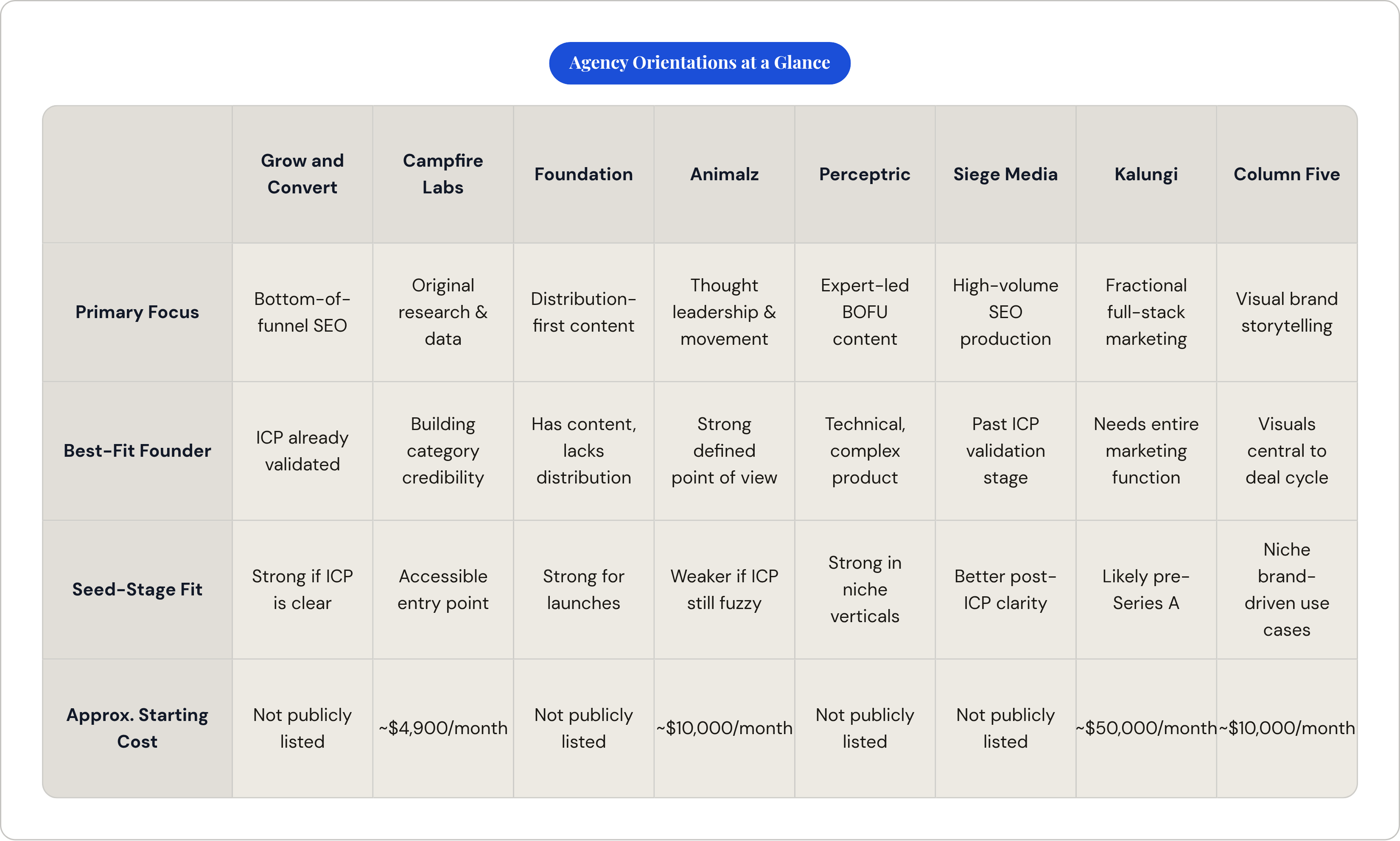
These aren't ranked. The right agency depends on your stage, your budget, and what you need to prove. Think of these as different orientations, not a leaderboard.
Grow and Convert
Primary orientation: Bottom-of-funnel SEO for B2B SaaS. Their methodology is built around generating trial signups and demo requests, not traffic volume.
Their Pain Point SEO framework maps content directly to what buyers are searching for at the decision stage. They've also built out Prioritized GEO frameworks as organic search continues to shift.
Best fit: Founders who have enough ICP clarity to know what problems their buyers are actively searching for. If you're still fuzzy on ICP, you'll want to resolve that first.
Campfire Labs
Primary orientation: Original research and proprietary data as the content foundation. Their work reads like journalism, not marketing collateral.
Their client list includes Dropbox, Notion, Stripe, and Mixpanel. Plans start around $4,900/month, which makes them accessible earlier than most on this list.
Best fit: Founders building thought leadership credibility in a defined category, where original data gives them something no competitor can replicate. If your differentiation is a perspective and a body of evidence, this is worth a conversation.
Foundation
Primary orientation: Distribution-first content. They engineer where content will go before a word gets written. Channel coverage spans search, LLMs, social, Reddit, and email.
A useful data point: a full GTM content strategy they ran across Product Hunt, Reddit, influencer outreach, and social resulted in 400 console sign-ups on launch day.
Best fit: Founders who have content but no distribution strategy. Also strong for founders planning a product or feature launch who need coordinated multi-channel execution.
Animalz
Primary orientation: Thought leadership and what they call "movement-first" content. They prioritize intellectual weight over SEO density. The work they produce tends to make people want to share it, not just rank for it.
Notable clients include Google, Intercom, and GoDaddy. They took Parabol's blog from near zero to over 150,000 monthly visits through long-form content journalism. Pricing likely starts around $10,000/month.
Best fit: Founders with a strong point of view and a category they want to own. Less suited to founders still finding their ICP. You need to know what you stand for before this kind of content can do its job.
Perceptric
Primary orientation: Revenue-driven, expert-led content with heavy bottom-of-funnel emphasis. They do expert interviews and deep domain research before writing. Strong niche experience in FinTech, API tools, DevOps, cybersecurity, and HR tech.
Their work with Katalon is worth noting. The company was producing high-ranking content that was attracting the wrong audience entirely. Perceptric's BOFU-led program increased traffic by 300% while targeting the right ICP.
Best fit: Technical founders in complex product categories where the content needs genuine domain depth to be credible. Generic content doesn't work in these categories. Buyers can tell immediately.
Siege Media
Primary orientation: End-to-end content production at scale with strong SEO and data-driven PR capability. They generate nearly $150 million in yearly client traffic value across their portfolio. Helped one client achieve a 751% increase in backlinks through a data-driven PR campaign.
Best fit: Founders who are past the ICP validation stage and need high-volume, high-quality content production with measurable SEO outcomes. This is less a fit for founders still figuring out messaging.
Kalungi
Primary orientation: Fractional marketing department. Content is one component inside a broader demand generation system. Founded by Microsoft marketing veterans. They operate with stage-specific playbooks, which matters at seed.
Full-service engagement starts at $50,000/month, which puts them above the typical seed budget. Worth knowing if you're approaching Series A and need the whole marketing function built.
Best fit: Founders who need more than content. They need the entire marketing function stood up from scratch.
Column Five
Primary orientation: Brand and content marketing with a strong visual storytelling heritage. Editorial, video, motion graphics, data visualization, research reports. They've been doing B2B content work since 2009. Clients include Databricks, Vercel, and Uber. Retainers from $10,000/month.
Best fit: Founders in markets where content needs to stand out visually, or where research reports and branded assets are central to how deals get closed.
What Good Agency Engagement Actually Looks Like for a Seed-Stage Founder
The agency cannot do this without you. That's the first thing to understand.
At seed, positioning context, ICP insight, product roadmap direction, and customer intelligence all live in the founder's head. The agency isn't going to find that on your website. You have to be a real participant in the early work, not a reviewer of deliverables.
What the first 60 days should look like:
- Messaging and positioning audit
- ICP definition work (this is real work, not a form to fill out)
- Channel selection based on where your buyers actually are
- First content pieces mapped directly to pipeline, not to a content calendar
What should not happen: a strategy deck that gets handed over and then sits while the agency starts producing content.
Metrics that should be visible from day one:
- Demo requests
- Pipeline influenced
- ICP-qualified leads
- Movement on CAC
Not traffic. Not rankings. Not yet.
Realistic timelines: Three to six months for consistent organic results. AI search visibility can build faster if content is structured for LLM citation, which is another reason to push agencies early on their GEO thinking.
One thing founders often underestimate: the traction evidence you build through content becomes part of your Series A story. Qualified pipeline growth, conversion rate improvement, ICP audience growth. Investors want to see that the GTM system works. Agencies that understand this build toward it. Agencies that don't treat it as someone else's problem.
Budget discipline matters here too. Even within the $5,000 to $15,000/month range typical at seed, the allocation matters. Content production budget should follow channel validation, not precede it.
The Signals That Tell You an Agency Isn't Built for Your Stage
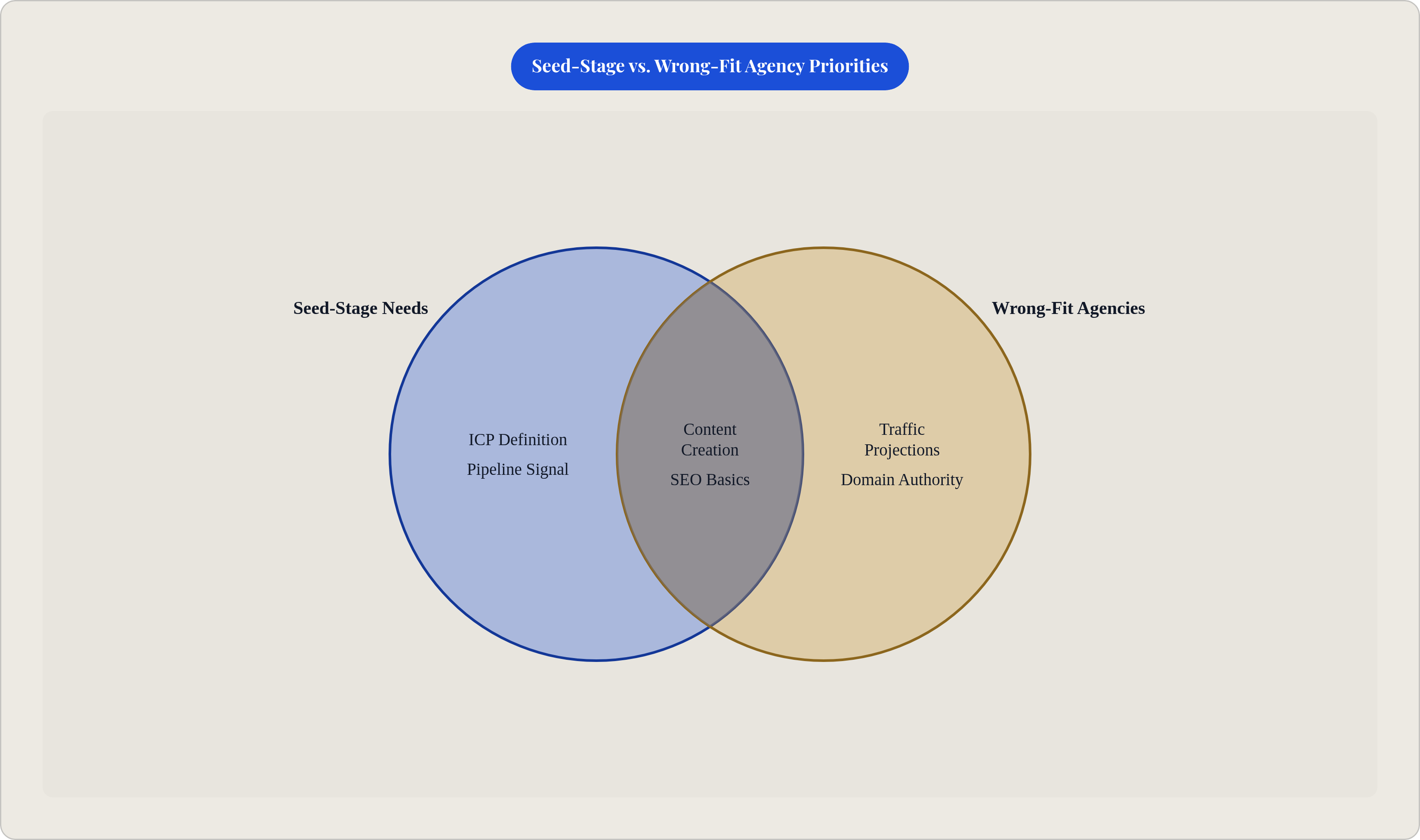
These aren't subtle. Once you know what to look for, they're fairly obvious.
They lead with traffic projections before asking who you're selling to. That's a fundamental sequencing problem. It tells you what they optimize for.
Their case studies measure success in pageviews, rankings, and domain authority but say nothing about pipeline or revenue influenced. They're measuring what's easy to measure, not what matters.
Their onboarding process doesn't include ICP definition or messaging validation. They're ready to write before they know who they're writing for. This is how you produce a lot of content that does nothing.
They can't explain their approach to AI search visibility in specific terms. In 2025, this is no longer optional knowledge. Vague answers here are meaningful data.
They propose high-volume content production in month one. Volume before validated messaging burns budget without generating signal. More content isn't more traction if the messaging is wrong.
Their client roster is all post-Series B or enterprise. The playbooks at that stage are materially different from seed. Longer timelines, more patience for brand building, more budget for experimentation. None of that applies to you right now.
They treat the engagement as a service delivery relationship rather than an execution partnership. At seed, you need an agency that knows your product. An agency that waits for a brief is a poor fit for this stage.
The right agency for a seed-stage SaaS founder isn't the most prestigious name on a listicle. It's the one that understands your window, builds toward pipeline traction inside it, and can tell you exactly how they plan to do it before you sign anything.