Account-Based Marketing Tools for Startups
ABM only works for startups with $25K+ deal sizes and a proven ICP.
Start here: should you even be doing ABM right now?
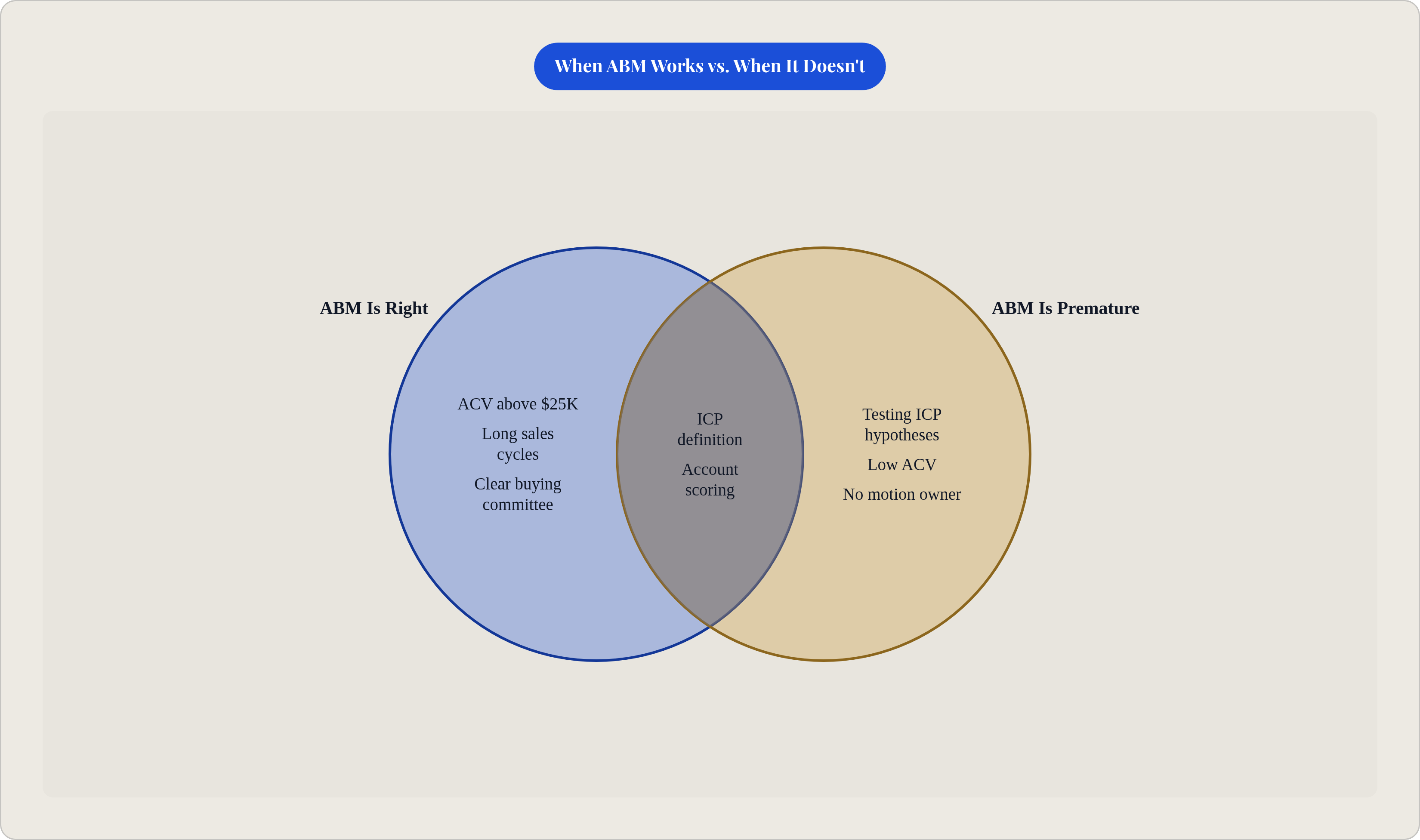
The clearest green light is deal size. If your average contract value is above $25K, the math starts to work. Below that, the time you spend personalizing outreach for each account will not pay back before you run out of runway. But ACV is not the only signal — a few others matter:
- Sales cycles are long. If closing a deal takes multiple touchpoints over weeks or months, accounts need sustained engagement. ABM is built for that.
- There is a real buying committee. More than 60% of B2B purchases involve four or more decision-makers. If your deal requires sign-off from multiple people, single-threaded outreach will lose. Every time.
- You have closed enough deals to see a pattern. Five to ten closed deals is usually the threshold. Once you can describe your best customers by industry, company size, buying trigger, and champion role, ABM gives you a way to turn what is already working into something repeatable.
When ABM is not the right move yet:
- You are still testing ICP hypotheses. At pre-seed, the job is to invalidate bad assumptions fast. Personalized campaigns slow that down considerably.
- Your ACV is low enough that broad content and inbound generate pipeline more efficiently.
- No one owns the motion. ABM without a clear owner and a measurement plan is just a very expensive distraction from channels that are actually working.
One thing to be clear-eyed about: ABM is a long-term strategy. Do not start it expecting pipeline in the first 90 days. The founders who get burned by ABM are almost always the ones who treated it like a short-term demand gen lever, got impatient at month two, and pulled the plug right before it would have started compounding. Think of ABM like a garden: you do not plant seeds on Monday and harvest on Friday. You tend, you wait, and the founders who walk away in week three never see what was about to bloom.
The ICP foundation that makes or breaks any ABM effort
An ICP is not a persona. A persona describes a person. An ICP describes a company — firmographics, technographics, buying behavior, the specific problem they are actively trying to solve. Get this wrong and every dollar and hour you spend on ABM is aimed at the wrong targets — like bringing a map to the right city but the wrong country.
Here is a straightforward way to build one:
- Pick four to six attributes: industry, company size, tech stack, geography, and a buying signal or trigger.
- Assign weights to each attribute based on how much it correlates with your best closed deals.
- Score your target accounts against those attributes. Accounts that clear a 70-plus score are worth ABM investment. Below that, broad content and inbound are a better use of your time.
The most common mistake at this stage is positioning too broadly. "We help B2B companies grow revenue" is not a differentiator. It is a placeholder. The strongest positioning targets one problem, one audience, one differentiator. Narrow positioning consistently outperforms in win rate and sales cycle length. It feels scary to narrow down. Do it anyway.
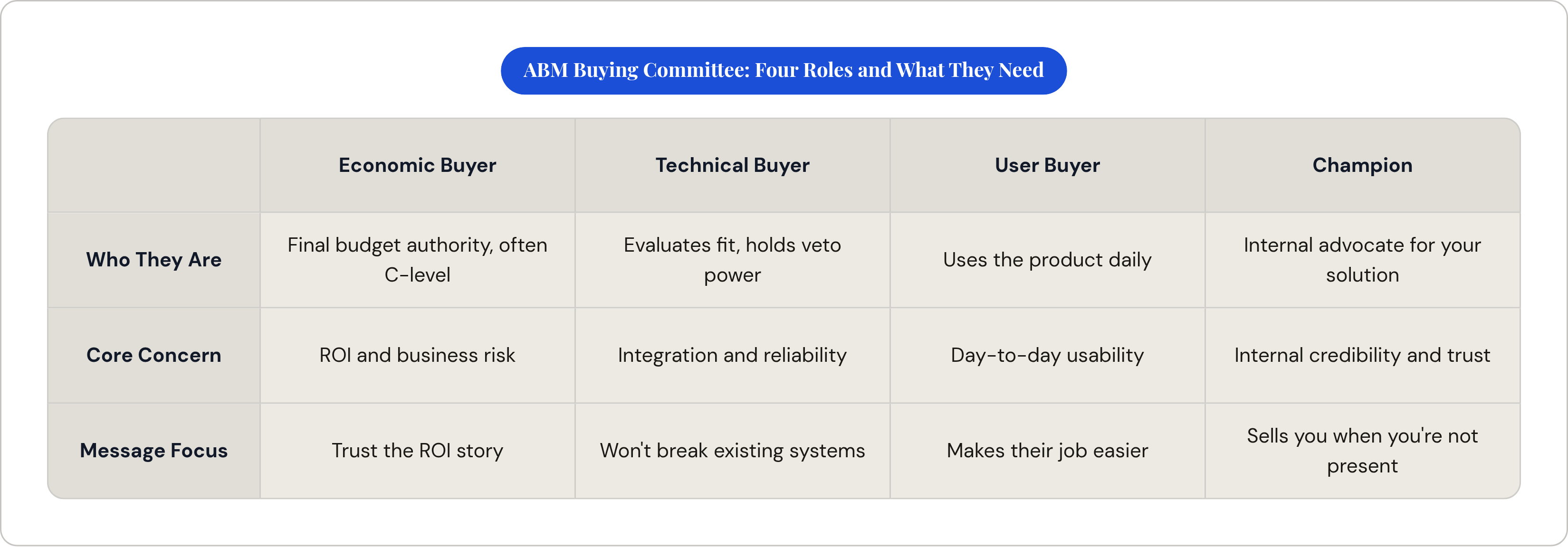
Once your ICP is defined, map the buying committee inside your target accounts. The four roles you care about:
- Economic Buyer. Final budget authority. Often C-level. They do not need to love your product. They need to trust the ROI story.
- Technical Buyer. Evaluates fit and can veto. They need to trust that you will not break anything.
- User Buyer. The person who lives in your product every day. They need to believe it makes their job easier.
- Champion. The internal advocate who sells you when you are not in the room. This one is the most important and the most neglected.
Buyers spend only 17% of their total purchase time actually meeting with vendors. That is a small window. A confused or mis-targeted touchpoint burns a slot that does not come back.
Before you open a single tool, build a scored target account list in a spreadsheet. Fifty to 100 accounts, ranked by ICP score. That list is your ABM foundation. Everything else is downstream of it.
The four functional jobs a startup actually needs ABM tools to do
Enterprise ABM platforms bundle everything into one expensive system. At seed stage, you are better off stitching together two or three focused tools that each do one job well. Four jobs actually need to get covered:
- Job 1: Account identification and prioritization. Which accounts fit your ICP and are showing buying intent right now?
- Job 2: Contact and buying committee data. Who are the right people inside those accounts, and how do you reach them?
- Job 3: Personalized outreach at scale. How do you reach multiple stakeholders with messaging that reflects their role, without needing a full SDR team behind you?
- Job 4: Account-level measurement. Is a target account engaging as a whole, across email, ads, and site visits?
One rule before you invest in any of this: run a target account list, personalized outreach, and basic tracking for 90 days first. Measure results at the account level. Then decide what tooling the next layer actually needs. Buying the stack before the motion is proven is how founders waste money and conclude ABM does not work, when really the problem was just sequencing.
Tools that handle account identification and intent data on a startup budget
This category answers one question: which of your target accounts are in-market right now? It uses behavioral signals like site visits, content consumption, and third-party intent data to tell you who is actively looking for a solution like yours.
Apollo.io is the strongest starting point for most seed-stage teams. It combines a prospecting database with basic intent signals and email sequencing in one tool, at a fraction of what enterprise intent platforms cost. It is useful for identifying buying committee contacts within a target account list and enriching firmographic data without a lot of manual work.
Clay has become the go-to enrichment tool for lean teams. It pulls from multiple data sources to build a rich account profile quickly. If you have the target account list but need to build out contact data and technographic context without hiring a research assistant, Clay handles that well. A lot of teams treat Clay like a secret weapon. It kind of is.
LinkedIn Sales Navigator is still the most reliable way to identify decision-makers, track job changes, and surface company signals within a defined account list. ICP-targeted LinkedIn campaigns consistently deliver higher ROI than broad targeting, and Sales Navigator is what makes that targeting actually work.
A note on enterprise intent platforms like 6sense and Bombora: the data they provide is genuinely valuable at scale. But it is priced for teams with enough pipeline volume to act on thousands of signals at once. A 50-account target list does not need a $60K intent data platform. Start with Apollo or Sales Navigator, validate that your ICP targeting is working, and layer in deeper intent signals once you have enough pipeline activity to benchmark against.
Tools that handle personalized outreach and multi-threaded engagement without a full SDR team
The core challenge here is coordination. ABM requires reaching multiple stakeholders inside the same account with messaging that is relevant to each person's role. That is operationally hard when you are the one running the whole motion.
For email sequencing, Apollo, Instantly, and Smartlead all handle account-level sequences without a lot of overhead. The key is building sequences that reflect the buying committee role. A message to the Technical Buyer should speak to integration risk. A message to the Economic Buyer should speak to ROI — not the same message, slightly tweaked. Actually different messages, for actually different concerns. That is what separates ABM sequences from spray-and-pray outreach.
For LinkedIn, two tactics work well together:
- LinkedIn Matched Audiences lets you upload a target account list and serve ads only to those accounts. Low minimum spend, measurable at the account level.
- Direct InMail and connection outreach via Sales Navigator for champion and economic buyer outreach, running in parallel with email.
For personalization at scale, Loom is underrated. A 90-second video referencing a specific account's situation outperforms templated email in enterprise deals consistently, and it takes about the same time to record as it does to write a decent cold email. Clay is also useful here because it can auto-generate personalized first lines from LinkedIn activity or recent company news, cutting manual research time dramatically.
What to avoid at this stage: any tool that requires SDR team management, complex workflow setup, or CRM integrations before it produces any output. A solo founder should be able to run the first campaign within a week. If onboarding takes longer than that, the tool is built for a team you do not have yet.
Tools that give account-level visibility into what's working
Here is where most startup analytics fall short. Google Analytics and a basic CRM report at the individual lead level. ABM requires knowing whether the account as a whole is engaging. Those are genuinely different questions, and conflating them is how you end up optimizing for the wrong thing.
Account-level measurement means tracking things like:
- Which target accounts have visited your site, how many times, and which pages?
- Which accounts have opened an email and visited the site in the same week? That multi-signal engagement is a much stronger buying indicator than either event alone.
- Pipeline velocity: how long from first touch to meeting booked to opportunity created, broken down by account?
HubSpot's free to starter tier can serve as the account-level tracking layer when set up correctly. The company object in HubSpot maps contacts to their parent account and tracks engagement aggregated at the company level. That is sufficient for a target account list under 200 accounts. Resist the urge to upgrade to Marketing Hub Enterprise until the ABM motion is proven. The upgrade will not fix a broken motion.
Factors.ai and similar tools are purpose-built for identifying which companies are visiting your site before they fill out a form. That anonymous visitor data is useful for warming a target account list with behavioral signals. More accessible than enterprise intent platforms, and worth adding once you have consistent site traffic from your ICP.
One thing worth flagging: account-level engagement data is not just useful for running campaigns. It is also evidence of a repeatable acquisition motion. A CAC payback period over 18 months is a serious problem at Series A. Account-level data is what lets you diagnose where the funnel is leaking before that number becomes a fundraising conversation you are not prepared for.
How to sequence tool adoption across the first 12 months of an ABM motion
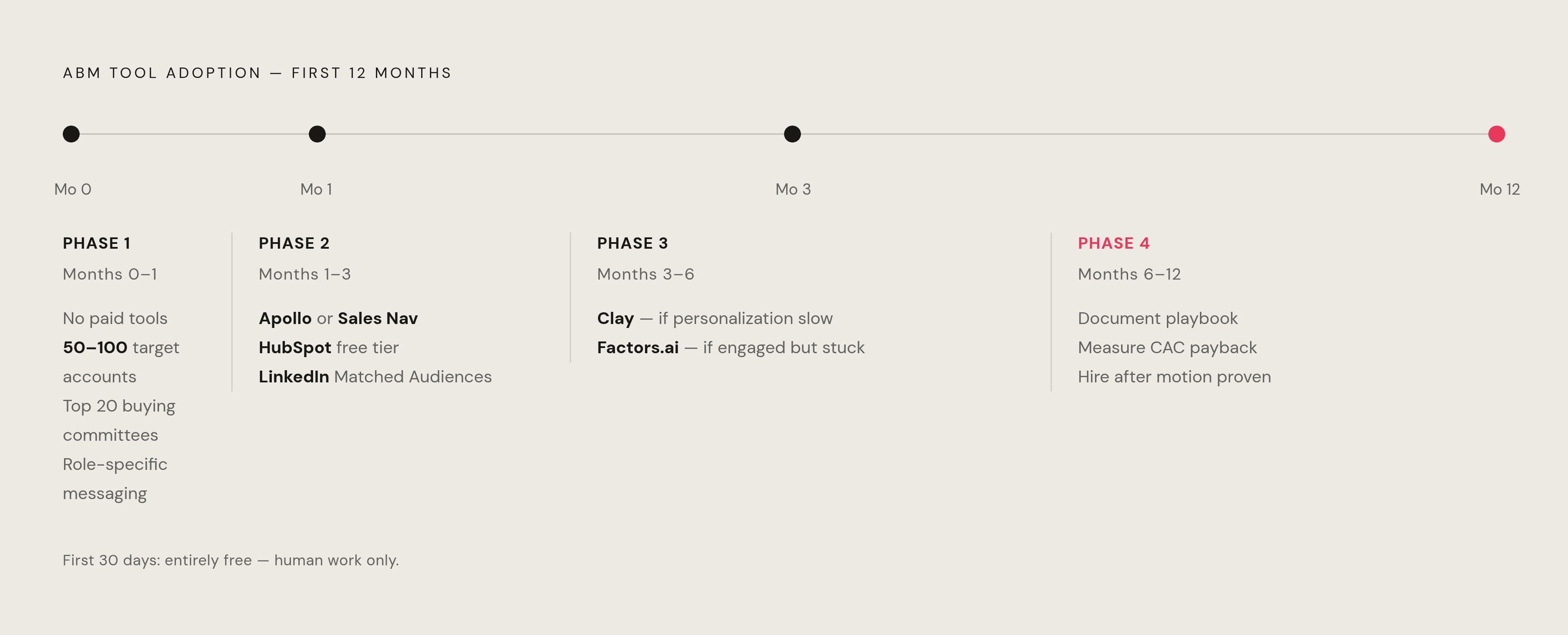
The single biggest mistake founders make with ABM tooling is buying the stack before the motion is proven. Here is a sequencing approach that actually fits the seed-stage operating model.
Months 0 to 1: Foundation before any tool spend
Hold off on paid tools for now. Do these three things first:
- Build the scored target account list in a spreadsheet. Fifty to 100 accounts, weighted by ICP fit criteria.
- Map the buying committee for your top 20 accounts. Economic Buyer, Technical Buyer, Champion.
- Write role-specific messaging for each committee role. One problem, one differentiator, one audience. Do not skip this step. It is the hardest part and also the most important, and most people skip it because it requires making real choices about positioning.
Months 1 to 3: Minimum viable ABM stack
Now you can spend a little money. The minimum viable stack:
- Apollo or Sales Navigator for account identification and contact data. Pick one, not both.
- HubSpot free tier as the CRM and account-level tracking layer.
- LinkedIn Matched Audiences with a small daily budget targeting your account list.
Run the first sequence. Measure at the account level for 90 days: engagement rate, meetings booked, opportunities created per account. That data tells you whether to keep going or adjust before you sink more into it.
Months 3 to 6: Add tooling only when the first layer is working
If outreach is converting but personalization is eating too much time, add Clay for enrichment and first-line generation. If accounts are engaging but still not converting, add Factors.ai or something similar to understand anonymous site behavior from target accounts. Do not upgrade to an enterprise ABM platform. The signal-to-noise ratio at a 100-account scale does not justify it, and the complexity will slow you down more than the features help.
Months 6 to 12: Systematize before you hire
Document everything that produced pipeline. The sequence, the messaging, the cadence. That documentation is the ABM playbook a future hire inherits. It is also proof, for yourself and for investors, that the motion is real and not just a founder doing heroic one-off outreach.
Start measuring CAC at the account level and CAC payback period. Begin building the data story for a Series A conversation. Hire or contract for ABM execution only after the playbook exists and the motion is proven. Hiring before that just means someone else is running experiments that you should have already run.
The underlying principle is simple. At seed stage, the goal is to prove that a repeatable, measurable motion exists for acquiring the right accounts. The tools are just in service of that proof. Get the proof first, then buy the tools that help you scale it.