B2B Startup Marketing Agencies Compared

Picking a B2B marketing agency at seed is one of those decisions that feels simple until you realize you've been optimizing for the wrong thing entirely. Most comparison lists rank agencies by client logos, service breadth, and team size. Fine criteria at Series B. At seed, almost completely irrelevant.
The real question isn't which agency is best at B2B marketing. It's which agency is actually built to operate under your constraints, toward your specific objectives, on your timeline. Most founders don't figure out those are different questions until they're three months into a $15K/month retainer and wondering why nothing is moving.
Here's what seed-stage marketing actually is: it's learning faster than you spend. Your ICP is still a hypothesis. Your messaging is still getting tested against real buyer conversations. Your sales cycle patterns are just barely starting to take shape from the handful of deals you've actually closed. That's just where you are. And an agency that doesn't understand that going in will cost you more than their retainer.
What this means for an agency relationship is pretty specific:
- Execution beats strategy. A positioning framework that never ships is worthless. You need someone who builds, not just plans.
- They need to operate without a full internal team. You probably don't have a head of marketing yet. The agency needs to fill that gap, not lean on it.
- Speed of iteration matters as much as correctness. Done is often better than perfect when the window to establish category presence is narrow.
- Metrics need to be investor-legible from day one. CAC, pipeline velocity, MQL-to-customer conversion. Not retrofitted six months later when someone asks.
Seed-stage marketing budgets are real and tight. Most startups at this stage allocate somewhere between 12% and 40% of revenue to marketing depending on growth targets. Every dollar needs to tie to a measurable outcome. An agency that brings enterprise ABM structures or mid-market demand gen frameworks into that environment isn't just a bad fit. It's a runway problem.
The axis that matters most: execution depth vs. strategy breadth
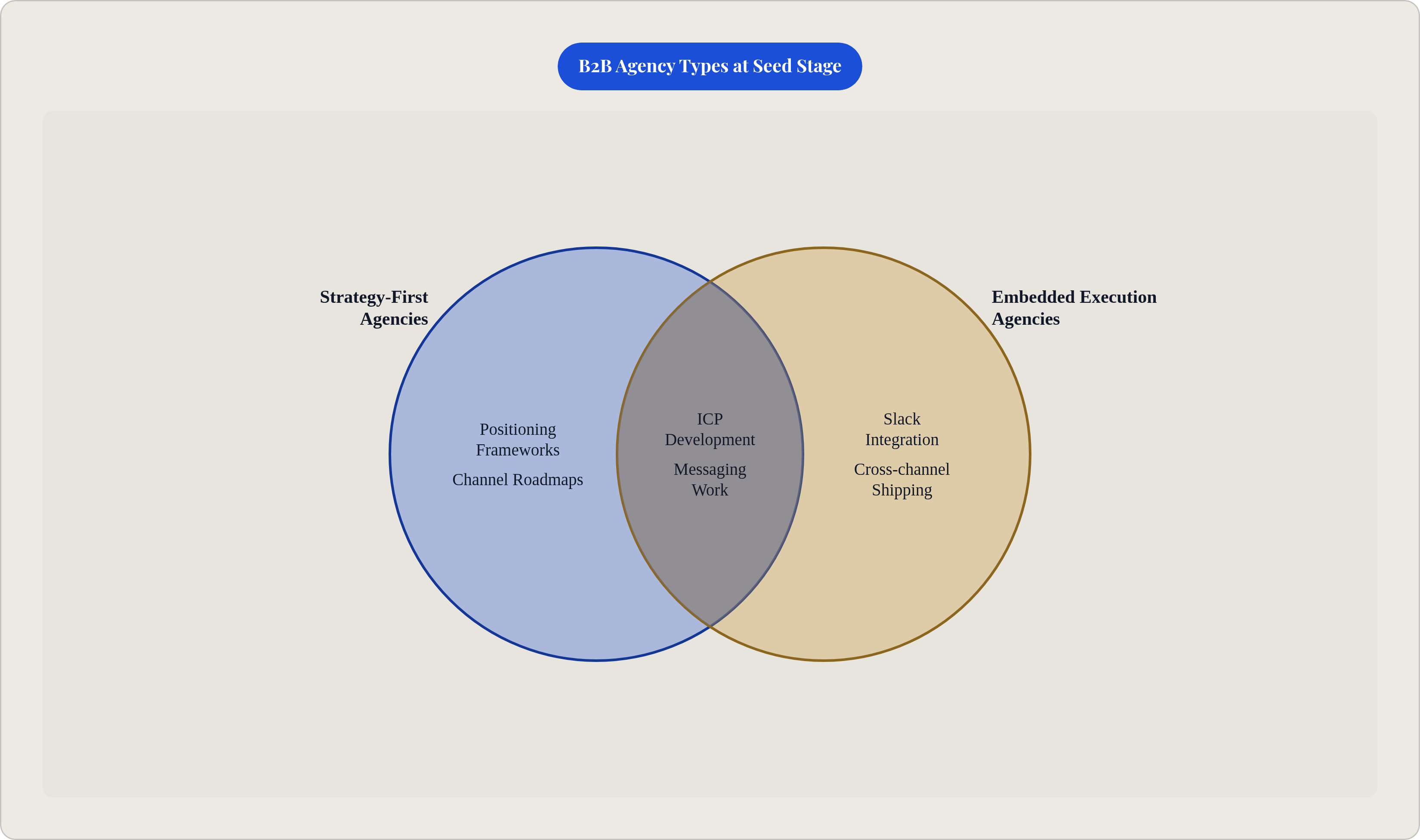
There are two dominant agency archetypes in B2B. Understanding the difference matters more than anything else on your evaluation checklist.
Strategy-first agencies deliver positioning documents, GTM frameworks, and channel recommendations. Valuable inputs. But inputs aren't outputs — like a GPS that gives you directions but won't start the car. At seed, you can't pay for a roadmap and then figure out how to drive it yourself.
Embedded execution agencies sit in Slack, know your product roadmap, and ship across positioning, SEO, content, email, paid, and conversion. End to end. They're building something that compounds over time, not billing you for discrete deliverables that don't talk to each other.
The structural tell is whether the agency's work connects. Does SEO feed content? Does content support paid? Does all of it tie to pipeline tracking? Or are they running isolated campaigns that live in separate buckets and never inform each other? That second model produces reports that look busy and pipelines that don't move.
When you're in a conversation with a finalist agency, ask these directly:
- What does a typical engagement look like in month one versus month six?
- Who on your team is accountable for pipeline, not just deliverables?
- What does the handoff look like when we eventually hire our first in-house marketer?
Before you sign anything: request a sample account plan, a measurement model, a messaging framework outline, and their attribution methodology. If they hedge on any of those, they're telling you something important.
How leading agencies in the B2B space are actually positioned — and who they're built for
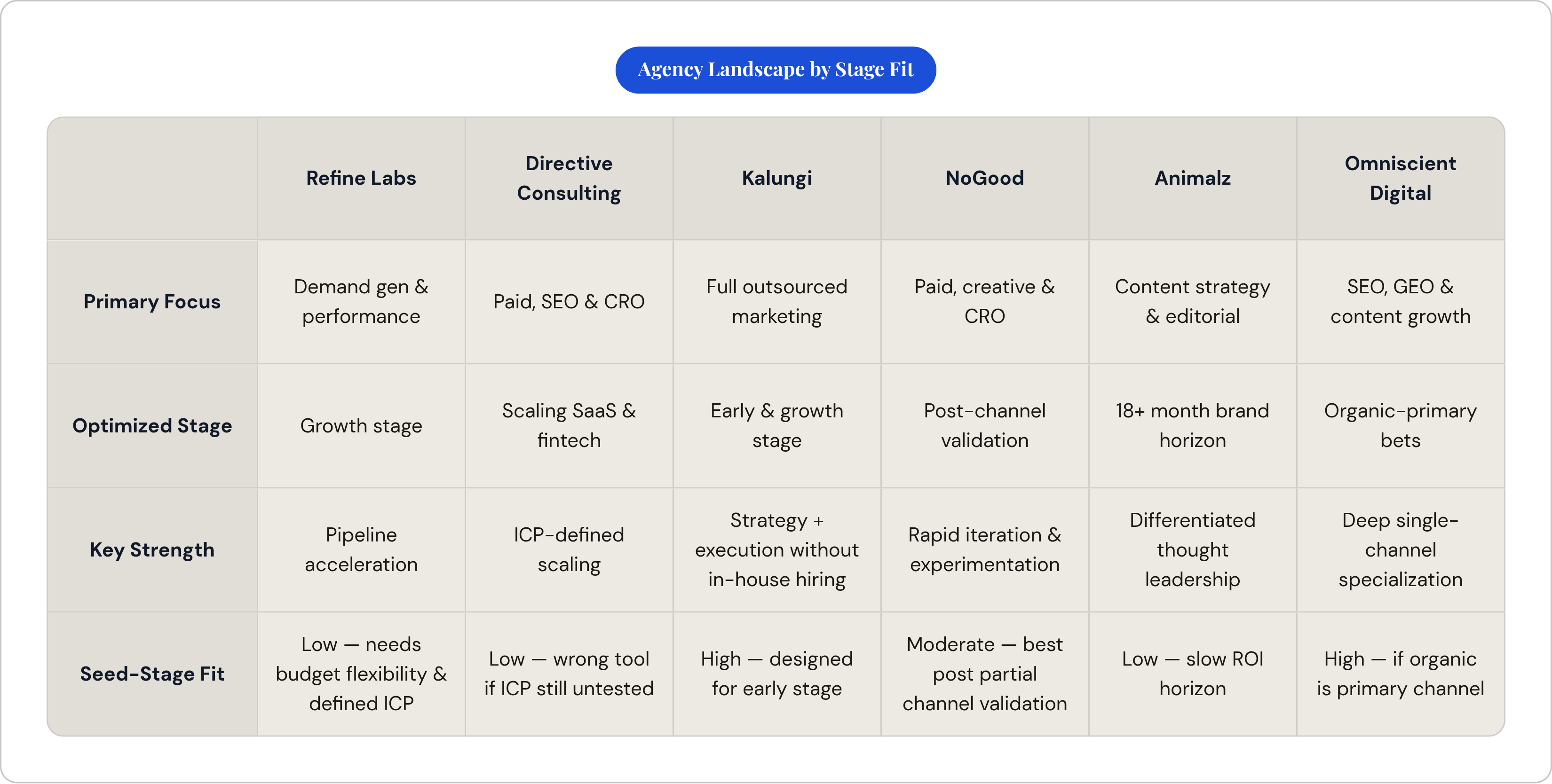
This isn't an exhaustive directory. It's a stage-sorted view of agencies that come up most often in founder conversations, evaluated by operating model and actual fit.
Agencies built for growth stage and beyond
These agencies are genuinely good at what they do. The problem is that what they do is optimized for a different stage than yours.
Refine Labs applies performance marketing principles to B2B demand gen. Strong for growth-stage companies with aggressive pipeline targets and shorter sales cycles. They require budget flexibility for failed tests and have limited brand planning capability. Not a seed fit.
Directive Consulting blends paid media, SEO, and CRO with a pipeline acceleration focus for B2B SaaS, fintech, and enterprise tech. Built for scaling companies with an established ICP. If you're still testing your ICP, this is the wrong tool for the job.
Heinz Marketing and Iron Horse are full-service mid-market partners. Strong for companies that already have a defined GTM and need execution at scale.
Demandbase and Momentum ITSMA are ABM specialists built for enterprise sales cycles. The volume and speed requirements at seed are fundamentally misaligned with how these shops operate.
Agencies with stronger early-stage fit
Kalungi operates as an outsourced marketing team for B2B SaaS, covering SEO, content, paid, and marketing automation. Explicitly designed for early and growth-stage companies that need both strategy and execution without internal hiring first.
Kaya is startup-focused paid media with proprietary AI tooling and a data-driven approach across Google, LinkedIn, and paid social. Good fit for founders who have validated a channel and want performance discipline applied to it.
NoGood takes a rapid experimentation approach across paid, creative, and CRO. Iterative by design. Good fit once you've partially identified your acquisition channels and want to push harder on them.
Demand Curve offers proven playbooks for paid media, lifecycle marketing, and funnel optimization. Efficient for founders who want structured process over bespoke strategy.
Content and organic specialists
Animalz does content strategy and editorial production for B2B software companies. The work is deliberate and differentiated, not high-volume output. Fits companies building thought leadership over an 18-plus month horizon.
Omniscient Digital specializes in SEO, GEO, and content as growth channels for B2B software. Strong fit when organic is your primary bet and you want someone who goes genuinely deep in that channel.
The general principle here: an agency that does everything at surface depth is almost always worse than one that goes deep in the one or two channels that actually drive growth at your stage.
Positioning and ICP sharpness as the hidden prerequisite for any agency to work
No agency can fix undefined positioning with more spend. That's not a knock on agencies. It's physics.
Here's a practical test. Can your newest SDR explain what you do in 15 seconds and get a prospect to say "tell me more"? If not, no agency can outspend that gap. Buyers spend only 17% of their purchase journey actually meeting with potential suppliers. With four or more decision-makers involved in most B2B purchases, your positioning needs to survive being relayed in a room you're not in, by someone who half-remembers what they heard on a demo call. Every link in that chain has to hold on its own.
A seed-stage agency should be able to do the following with positioning specifically:
- Audit your current messaging against actual evidence from closed deals
- Apply a working framework, whether that's StoryBrand, the Value Proposition Canvas, or an equivalent, to make positioning buyer-legible rather than founder-legible
- Treat ICP as a living hypothesis that gets refined as sales patterns clarify, not as a slide deck that gets locked after workshop one and never touched again
The red flag to watch for: any agency that opens with a channel plan before doing positioning work has the sequence backwards. That approach produces optimized delivery of the wrong message. You will spend money reaching the right people with something they don't understand, or the wrong people with something that sounds relevant to everyone. Neither is good. Teams with a documented, scored ICP report meaningfully higher win rates and shorter sales cycles. Fix positioning first, or hire an agency that fixes it with you.
What the Series A timeline means for how you evaluate agency fit today
The average time between a seed round and a Series A has stretched to around 25 months. Two years to build the content library, pipeline history, and metrics narrative that investors will actually scrutinize.
Series A benchmarks as of 2025 are unforgiving. The median ARR threshold is around $2.5M, roughly 75% higher than 2021 levels. Growth needs to be above 100% year over year. LTV:CAC needs to hit 3.5:1 or better. And you need six or more consecutive months of 15% to 20% month-over-month growth. Not one strong quarter surrounded by noise.
That last point matters more than most founders realize. Consistency beats spikes. An agency that produces one great quarter and then flatlines is a liability in a fundraising narrative, not an asset. Investors have seen enough "hockey stick" decks to know when one good month is being stretched into a trend.
Net revenue retention matters too. Median NRR for private B2B SaaS in 2025 is around 106%, per SaaS Capital. Below 100% NRR ends most Series A conversations before they start. The agency's work on retention messaging and lifecycle content isn't secondary to acquisition. It runs parallel to it, and investors will look at both.
Investors spend an average of under four minutes reviewing a pitch deck. They're not evaluating your product in that moment. They're evaluating whether you can reach customers efficiently and repeatedly. The agency you hire at seed is building the evidence base for that moment. Their metrics discipline, attribution methodology, and reporting cadence either produce a fundable narrative or they don't.
An agency that cannot connect its work to CAC, pipeline velocity, and MQL-to-customer conversion is not a partner for this stage. That's true regardless of their B2B credentials.
The criteria that actually separate the right agency from a plausible-looking wrong one
Stage-fit questions for the first conversation
- What percentage of your current clients are at seed or pre-Series A?
- What does your typical engagement look like when a client doesn't yet have a documented ICP?
- How do you define success at month three versus month twelve?
- What investor-legible metrics do you report on by default?
Operating model signals
- Do they embed in your workflow or deliver from the outside?
- Is their team structured to execute across channels, or to hand off to your internal team once someone gets hired?
- Are they building systems or running campaigns? There is a real difference, and it shows up fast. Systems compound. Campaigns stop when you stop paying.
Retention and proof signals
Ask for current client references, not case studies. Case studies are curated. Reference calls are not. Ask how many of their clients have successfully raised a Series A after working with them. Request a sample measurement model and attribution methodology before you sign anything. If they can't produce those, you have your answer.
The channel-fit question
Match the agency's depth to your primary growth bet. An organic-first company needs an organic specialist. A paid-first company needs a performance specialist. A generalist operating at surface depth in both is a dilution of budget you don't have room to waste.
Budget and runway discipline
The agency should be able to tell you exactly what a measurable outcome looks like at your current budget level. If they can't, they aren't built for the constraints you're actually operating under. That's a disqualifier, full stop.
The decision isn't which agency is the best B2B agency in the market. It's which agency is designed to operate under your specific constraints, toward your specific objectives, on your timeline. One of those questions has a useful answer. The other just produces a list of logos.